
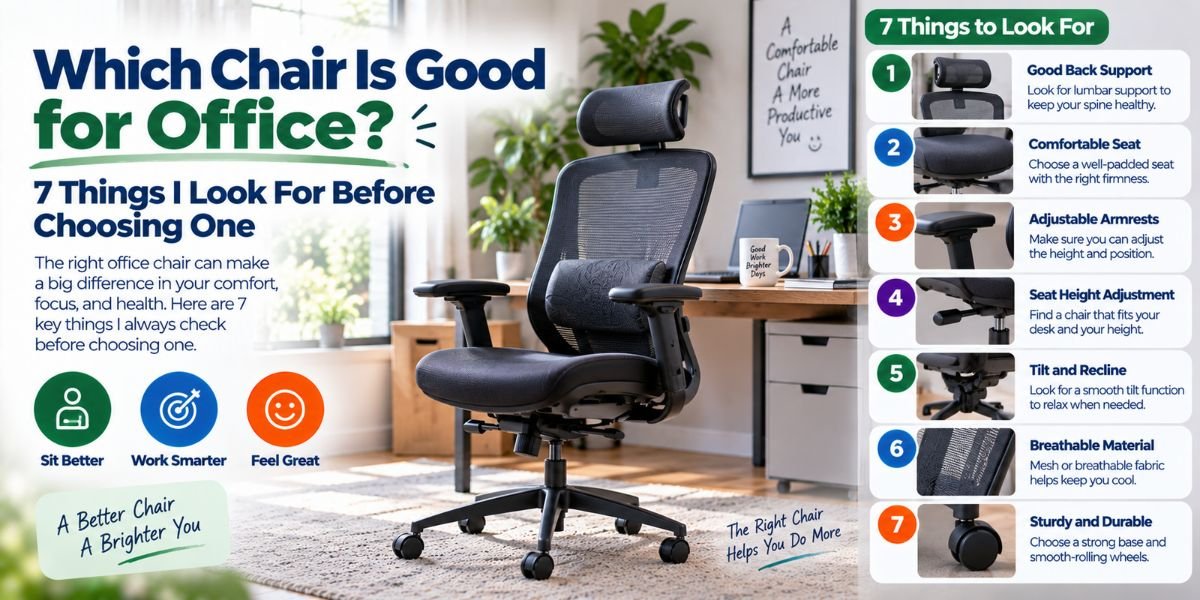
If you sit at a desk for hours, your office chair matters more than it may seem. A chair can change how your back, neck, legs, and arms feel during a long workday.
So, which chair is good for office use? For most people, I would look for an ergonomic chair with good lower-back support, adjustable seat height, enough seat depth, and comfortable armrests. The goal is not to find the softest chair. The goal is to find one that keeps your body in a natural position.
I also think adjustability matters more than fancy looks. A chair may look great in a home office, but if you cannot adjust it to fit your body, it may become uncomfortable after a few hours.
Which Chair Is Good for Office Work?
The best office chair is one that supports your body while letting you adjust the chair to your desk and working style.
A good office chair should have:
- Adjustable seat height
- Good lower-back support
- A comfortable seat
- Adjustable or useful armrests
- A backrest that supports your upper body
- A stable five-point base
- Easy controls
- Enough room to change sitting positions
There is no single chair that fits everyone. Body size, desk height, work hours, and sitting habits all matter.
For this reason, I would not choose a chair based only on its appearance or price. I would first check how well it can fit the person using it.
Why Ergonomics Matter in an Office Chair
Ergonomics is simply about making a workspace fit your body.
This matters because office work often means sitting in one place for a long time. If the chair is too high, too low, too deep, or poorly supported, you may start changing your posture just to feel comfortable.
A good ergonomic chair gives you more control.
You can raise or lower the seat. You can adjust the back support. You can move the armrests when needed. Some chairs also let you change the seat depth or recline angle.
These small adjustments can make a big difference during a full workday.
1. Choose a Chair With Adjustable Seat Height
Seat height is one of the first things I would check.
Your feet should rest comfortably on the floor when you sit at your desk. Your knees should also be in a comfortable position rather than being forced too high or left hanging.
A chair that is too high can leave your feet without proper support. A chair that is too low can make it harder to work comfortably at your desk.
An adjustable seat lets you find a better position.
This is especially useful when the chair will be used by different people. One fixed height may work for one person but feel wrong for another.
2. Look for Good Lower-Back Support
Lower-back support is another major factor.
Many people lean forward while reading, typing, or looking at a screen. Over time, this can make a poorly supported chair feel tiring.
A useful backrest should support the natural curve of your lower back. Some office chairs have adjustable lumbar support, while others use a fixed shape.
I prefer having some way to adjust the support because people have different body shapes.
The support should not feel like a hard object pushing into your back. It should provide support without becoming distracting.
3. Check the Seat Depth and Width
A comfortable seat needs enough room for your body.
If the seat is too narrow, you may feel squeezed. If it is too deep, you may have trouble sitting back while keeping your legs in a comfortable position.
Seat depth is often overlooked when people shop for office chairs.
I would sit all the way back in the chair and check whether the seat still feels comfortable behind my legs. There should be enough space for a relaxed sitting position without the front edge pressing into the back of the knees.
This simple check can tell you a lot about whether a chair is a good fit.
4. Do Not Ignore the Armrests
Armrests can help reduce the effort needed to hold your arms while typing or using a mouse.
But armrests can also cause problems when they are the wrong height or shape.
If they are too high, they may push your shoulders upward. If they are too low, they may not provide useful support.
Adjustable armrests are helpful because you can set them to match your body and desk.
I also like armrests that do not get in the way when I move closer to the desk. This is a small detail, but it can affect how naturally you sit.
5. Pick the Right Backrest
The backrest should support your body without forcing you into one stiff position.
A taller backrest can provide more support for the upper back. A mid-height backrest may feel less bulky and can work well in smaller spaces.
A reclining function can also be useful.
You do not need to sit perfectly upright every second of the day. Being able to change your position can make long periods of desk work feel easier.
Still, reclining is not a replacement for good support. The backrest should remain supportive when you change positions.
6. Think About the Seat Material
The material can affect comfort, heat, and long-term use.
Fabric seats often feel soft and breathable. They can be a good choice for people who sit for many hours.
Mesh chairs allow more airflow. This can be useful in warm rooms or during long work sessions.
Leather and synthetic leather can look more polished and may be easy to wipe clean. However, some people may find these materials warmer than mesh or fabric.
There is no perfect material for everyone.
If I were choosing a chair for a warm home office, I would pay close attention to airflow. If easy cleaning matters more, a wipe-clean surface may make more sense.
7. Make Sure the Chair Matches Your Desk
Even a good chair can feel wrong if it does not work with your desk.
Your chair height, desk height, monitor position, and keyboard position all work together.
For example, raising your chair to reach a tall desk may leave your feet without good support. Lowering the chair too much may make your arms sit at an awkward angle while typing.
This is why I would not judge an office chair by itself.
The real question is: does the chair work with the entire workstation?
Office Chair Features That Are Worth Paying For
Not every extra feature is useful.
Some features can make a real difference, while others may simply increase the price.
| Feature | Why it matters |
|---|---|
| Adjustable seat height | Helps match the chair to your body and desk |
| Lumbar support | Supports the lower back |
| Adjustable armrests | Helps position the arms comfortably |
| Seat-depth adjustment | Useful for different leg lengths |
| Recline function | Lets you change sitting positions |
| Breathable material | Can improve comfort in warm rooms |
| Strong base | Helps with stability and daily use |
| Smooth casters | Makes moving around easier |
I would spend more on adjustability and support before paying extra for decorative features.
A headrest, for example, may be useful for some people. But it is not automatically necessary for normal desk work.Read moreWhat Type of Office Chair Is Best: The Right Chair for Long Workdays
Which Office Chair Is Best for Long Hours?
If you work at a desk for many hours each day, I would focus on adjustability first.
Look for a chair that lets you change the seat height and provides solid back support. Adjustable armrests and seat depth are also helpful.
Breathable material can matter if your office gets warm.
I would also choose a chair that allows small changes in posture. Staying in exactly one position for hours is not ideal, even when the chair itself is comfortable.
Your chair should make it easy to shift, recline slightly, sit upright, and move when needed.
Which Chair Is Good for a Small Home Office?
A smaller office does not always need a large executive chair.
For a compact workspace, I would look for a chair with a simple shape and a useful adjustment range.
A bulky chair can take up valuable floor space. It may also make it harder to move around a small desk.
Mesh or slim ergonomic chairs can work well in these spaces. Just make sure the smaller design does not remove the support you actually need.
A compact chair is only useful if it still fits your body.
What About Gaming Chairs for Office Work?
Gaming chairs can look attractive, but looks should not be the main reason to choose one for office work.
Some gaming chairs offer useful adjustments, reclining, and strong support. Others focus more on appearance than long-term desk comfort.
I would judge a gaming chair the same way I judge any office chair.
Check the seat height, back support, armrests, seat depth, material, and adjustment range.
If those features fit your needs, the gaming label does not matter much.
Common Office Chair Mistakes
One common mistake is choosing a chair because it feels very soft.
A soft chair may feel great for the first few minutes. That does not mean it will be comfortable after a long work session.
Another mistake is ignoring the chair’s size.
A chair designed for a larger person may feel too wide for someone with a smaller frame. A compact chair may feel restrictive for someone who needs more space.
I would also avoid buying a chair only because it has many features. More controls do not always mean better comfort.
The important thing is whether those controls help you find a good sitting position.
How I Would Set Up an Office Chair
Once I have the right chair, I would adjust it before starting a long workday.
First, I would set the seat height so my feet have good support.
Next, I would sit back and adjust the back support so it feels natural. Then I would set the armrests so my shoulders can stay relaxed while working.
After that, I would check the desk and monitor.
The screen should be positioned so I do not need to keep bending my neck down. The keyboard and mouse should also be close enough that I do not need to reach far forward.
A good chair works best when the whole desk setup is adjusted with it.
How Much Should You Spend on an Office Chair?
There is no single price that guarantees a good chair.
A low-cost chair can work well for light use if it fits your body. A more expensive chair may be worth it for someone who spends most of the day at a desk.
I would pay for useful features rather than a premium name.
If two chairs have similar support and adjustment options, I would compare comfort, build quality, warranty, and ease of adjustment before choosing the more expensive one.
The best value is the chair that fits your body and your daily work.
Who Should Choose an Ergonomic Office Chair?
An ergonomic office chair makes the most sense for people who spend a large part of the day working at a desk.
It can also be useful for students, remote workers, gamers, and anyone who uses a computer for long periods.
If you only sit at a desk for a short time each day, you may not need every adjustment available.
But if your chair is part of your daily routine, comfort and fit deserve more attention.
FAQs
Which chair is good for office work?
An ergonomic chair with adjustable height, good lower-back support, and comfortable seating is a strong choice. Look for a chair that fits your body and desk.
Is a mesh chair good for office use?
Yes. Mesh can provide good airflow and may feel cooler during long work sessions. The key is still proper support and a good fit.
Should an office chair have a headrest?
Not always. A headrest can be useful when you often recline, but it is not required for every office setup.
Is a gaming chair good for office work?
It can be. Judge it by support, adjustability, seat comfort, and fit rather than its gaming design.
What is the most important office chair feature?
For most people, fit and adjustability are among the most important factors. A chair should let you set the seat and support areas to match your body.
Conclusion
So, which chair is good for office use? I would choose an ergonomic chair that fits my body, supports my lower back, and gives me enough adjustment to work comfortably.
Do not focus only on looks, price, or the number of features. Check the seat, backrest, armrests, height, material, and fit with your desk.
The right office chair should make your work setup feel easier, not more complicated. When the chair fits well, you can focus more on your work and less on how uncomfortable your seat feels.