
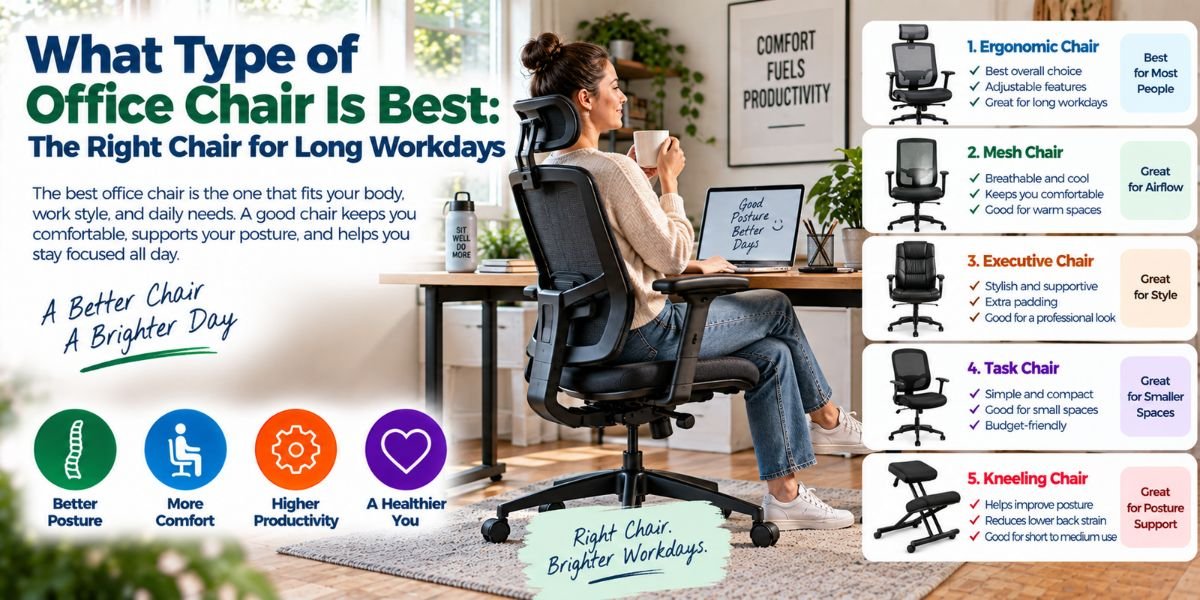
If you sit at a desk for hours, the right office chair can make a big difference. A chair that looks great may not feel great after a long workday.
So, what type of office chair is best?
For most people, an ergonomic office chair is the best choice. It should support your lower back, let your feet rest flat, and allow easy height and seat adjustments. A good chair should also fit your body and desk.
I have found that the best chair is not always the most expensive one. The right fit, support, and adjustability matter more.
What Type of Office Chair Is Best?
The best type of office chair for most people is an ergonomic chair with adjustable support.
A good ergonomic chair should let you adjust key parts to match your body. These may include seat height, seat depth, back support, armrests, and recline.
This matters because people do not all have the same body shape. A chair that feels perfect for one person may feel wrong for another.
For long hours at a desk, I would look for these main features:
- Adjustable seat height
- Good lower-back support
- A comfortable seat
- Adjustable armrests
- A backrest that supports your upper body
- A stable five-point base
- Smooth recline
- A seat that fits your body
- Breathable material if you work in a warm room
The goal is simple. You want a chair that supports you without forcing your body into one stiff position.
Why an Ergonomic Office Chair Is Usually the Best Choice
Ergonomic chairs are designed around how people sit and work.
They usually offer more adjustments than basic office chairs. This makes it easier to set the chair for your height, desk, and sitting habits.
One thing I like about adjustable chairs is that they give you room to change your position. You can sit more upright when typing. You can lean back when reading. You can also change your arm position during the day.
That flexibility can be more useful than extra padding or a fancy design.
An ergonomic chair is especially useful if you spend most of your workday at a desk.
The Best Office Chair Depends on How You Work
There is no single chair that is perfect for everyone.
Your work style should help guide your choice.
Best for Long Computer Work
If you work at a computer for many hours, choose an ergonomic office chair with strong adjustability.
Look for a chair that supports your lower back and allows you to set the seat height correctly. Adjustable armrests can also help you keep your arms in a more natural position while typing.
A breathable back can be useful if you tend to get warm while working.
Best for Home Offices
For a home office, comfort and size both matter.
A large executive-style chair may look impressive. But it can take up a lot of space. If your office is in a bedroom or small room, a compact ergonomic chair may work better.
I would also think about how the chair looks in the room. You want something that fits your workspace without making the room feel crowded.
Best for Gaming and Work
A gaming chair can work for desk work, but it is not automatically the best office chair.
Some gaming chairs have good adjustments and strong support. Others focus more on appearance and thick padding.
If you use one for work, judge it like an office chair. Check the seat, back support, armrests, recline, and overall fit.
The gaming look should be secondary to comfort and support.
Best for Executive Offices
An executive chair can be a good choice if you want a larger seat and a more traditional look.
These chairs often use thick padding and larger backrests. That can feel comfortable for short periods.
The downside is that a soft, oversized chair is not always ideal for long computer sessions. Some models also have fewer useful adjustments than a good ergonomic chair.
What Makes an Office Chair Comfortable?
Comfort is more than soft padding.
A chair can feel very soft when you first sit down and still become uncomfortable later.
I pay more attention to how the chair supports the body over time. The seat should not put too much pressure on one area. The backrest should support you without pushing you into an awkward position.
Seat depth is also important.
If the seat is too deep, you may have trouble sitting back while keeping your feet in a good position. If it is too short, your thighs may not get enough support.
That is why adjustability is so useful.
How High Should an Office Chair Be?
Your office chair should be high enough for your feet to rest flat on the floor while your knees stay in a comfortable position.
Your desk also matters.
If your chair is set correctly but your desk is too high, your arms may still feel awkward while typing.
When I set up a desk chair, I think about the whole workstation instead of the chair alone.
The chair, desk, monitor, keyboard, and mouse should work together.
Lower-Back Support Matters
Lower-back support is one of the most important features to consider.
The lower part of the backrest should support the natural curve of your lower back. Some chairs have adjustable lumbar support, which gives you more control.
I prefer adjustable support when possible. It lets you move the support to a position that feels right for your body.
Do not assume that the strongest lumbar support is always better. Too much pressure in one spot can be uncomfortable.
The right amount of support should feel supportive without becoming a distraction.
Are Adjustable Armrests Worth It?
Yes, adjustable armrests can be very useful.
Your armrests should allow your arms to rest comfortably without forcing your shoulders upward.
This is especially helpful if you type or use a mouse for many hours.
A chair with adjustable armrests gives you more control over your setup. You can change their height and, on some chairs, their angle or position.
Fixed armrests can still work. But they offer less flexibility.
Should an Office Chair Have a Headrest?
A headrest is not essential for everyone.
If you sit upright and spend most of your time typing, you may not use it much.
A headrest can be more useful when you often recline. It can give your head and neck a place to rest while reading, thinking, or taking a break.
I would not choose a chair just because it has a headrest. First, make sure the seat and back support fit you well.
Mesh vs. Fabric vs. Leather Office Chairs
The material can change how a chair feels.
Mesh
Mesh is popular because it allows more airflow.
This can be helpful in warm rooms. A mesh back may feel cooler than a thick padded back.
The feel can also be firmer and less cushioned.
Fabric
Fabric chairs can offer a soft and familiar feel.
They may work well in home offices because they come in many simple designs. The main concern is cleaning, especially if you eat or drink near your desk.
Leather and Faux Leather
Leather-style chairs often have a polished look.
They can be easy to wipe clean. However, some materials can feel warm after long periods of sitting.
For a warm workspace, I would think carefully about breathability before choosing a leather-style chair.
What Office Chair Is Best for a Small Space?
For a small office, I would choose a compact ergonomic chair.
Look for a chair with a reasonable seat size and a base that does not take up too much floor space.
Avoid buying a huge chair simply because it looks comfortable.
Your chair should leave enough room to move around the desk. It should also allow you to push it under the desk when you finish working.
A smaller chair can make a home office feel much easier to use.
Common Office Chair Mistakes
Buying a chair based only on appearance is a common mistake.
A beautiful chair may not fit your body.
Another mistake is choosing the softest chair you can find. Extra-soft padding may feel great at first but does not always provide the support you need during a long workday.
I also would not ignore the desk height. Even a good chair can feel wrong if the whole workstation is poorly adjusted.
Finally, do not assume that a high price guarantees comfort.Read moreWhat Is the Most Popular Office Chair? I Found the Chairs People Keep Choosing
What Should You Look for Before Buying?
Before buying an office chair, check these points:
| Feature | What to Look For |
|---|---|
| Seat height | Easy adjustment for your body and desk |
| Seat depth | Enough thigh support without forcing your knees |
| Backrest | Comfortable support for your back |
| Lumbar support | Support that fits your lower back |
| Armrests | Adjustable when possible |
| Recline | Smooth movement with stable support |
| Material | Choose based on climate and comfort |
| Base | Stable five-point design |
| Wheels | Smooth movement on your floor |
| Size | Fits both your body and workspace |
Do not try to judge a chair from the product photo alone.
The important question is how the chair will fit your body and your daily routine.
How I Would Choose an Office Chair
I would start with the basics.
First, I would check the chair’s size and adjustment range. Then I would look at the seat and back support.
After that, I would check the armrests and recline.
I would also think about where the chair will be used. A chair for a cool office may not be ideal for a hot room. A large chair may not make sense in a small home office.
Most of all, I would avoid paying extra for features I will never use.
A simple ergonomic chair with useful adjustments can be a better choice than a large chair packed with extras.
Is a More Expensive Office Chair Better?
Not always.
More expensive chairs may offer better materials, more adjustments, stronger construction, or longer warranties. But price alone does not tell you how well a chair will fit your body.
A cheaper chair can be a good choice if it has the adjustments and support you need.
At the same time, buying the cheapest chair can be a false saving if it does not feel comfortable for your daily work.
I would focus on value rather than price.
What Type of Office Chair Is Best for You?
For most desk workers, I would start with an ergonomic office chair.
If you work long hours, prioritize adjustability and back support. If your room gets warm, consider a breathable mesh design. If space is limited, choose a compact model.
If appearance matters, an executive chair may suit your room better. If gaming and work share the same desk, a gaming chair can work if its support and adjustments are good.
The best office chair is the one that fits your body, your desk, your space, and the way you work.
FAQs
What type of office chair is best for long hours?
An ergonomic office chair is usually the best choice for long work sessions. Look for adjustable height, good back support, a comfortable seat, and useful armrest adjustments.
Is an ergonomic chair better than a normal office chair?
Usually, yes, if you spend many hours at a desk. Ergonomic chairs often offer more adjustments, which can make it easier to fit the chair to your body.
Is a mesh office chair good for long hours?
A mesh chair can be a good choice for long workdays, especially in warm rooms. It allows more airflow, but the firmness and support should still feel comfortable to you.
Should an office chair have lumbar support?
Yes, lower-back support is useful for many desk workers. Adjustable lumbar support can be even better because you can position it to suit your body.
How much should I spend on an office chair?
There is no single price that guarantees a good chair. Focus on fit, support, adjustment options, build quality, and your daily needs rather than choosing by price alone.
Conclusion
So, what type of office chair is best?
For most people, I would choose an adjustable ergonomic office chair. It gives you the flexibility to set the seat, back support, and armrests to match your body and desk.
But there is no perfect chair for everyone.
Your height, workspace, climate, work habits, and personal comfort all matter. Instead of chasing the most expensive or most stylish chair, look for one that supports you well and fits the way you actually work.