
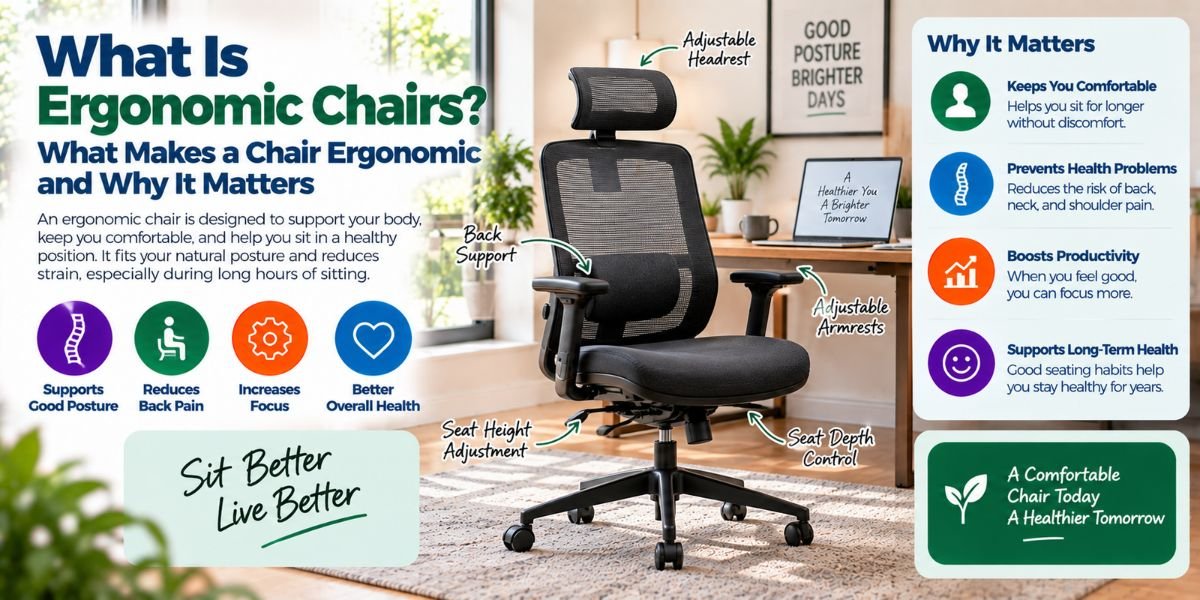
If you spend hours at a desk, you have likely heard the term ergonomic chair. But what does it really mean?
The simple answer is this: an ergonomic chair is made to support your body while you sit and work. It is designed around comfort, posture, movement, and adjustability.
That sounds simple, but there is more to it. A good ergonomic chair is not just a chair with extra padding. It should help you sit in a more natural position. It should also let you adjust the chair to fit your body.
In this guide, I will explain what is the meaning of ergonomic chair, what makes a chair ergonomic, and what features are worth looking for.
What Is the Meaning of Ergonomic Chair?
The meaning of an ergonomic chair is a chair designed to support the human body during sitting. It aims to make long periods of sitting more comfortable by supporting areas such as the lower back, upper back, neck, arms, and legs.
The word ergonomic means something is designed to fit the needs of the person using it.
So, an ergonomic chair is not one fixed type of chair. It can have many different shapes and features.
The key idea is adjustability.
A chair may have a good backrest, but if the seat is too high for you, it may still feel uncomfortable. The same is true if the armrests are too high or the lumbar support does not line up with your lower back.
That is why I look at an ergonomic chair as a chair that can be adjusted to the user, rather than simply a chair that looks comfortable.
How Is an Ergonomic Chair Different From a Regular Chair?
A regular office chair may provide a place to sit, but it may offer only a few adjustment options.
An ergonomic chair usually gives you more control over your sitting position.
For example, you may be able to adjust:
- Seat height
- Seat depth
- Backrest position
- Lumbar support
- Armrest height
- Armrest position
- Recline tension
- Recline angle
- Headrest position
Not every ergonomic chair has all of these features.
This is important because there is no single chair setting that works for everyone. People have different heights, leg lengths, torso lengths, and working habits.
An ergonomic design gives you more ways to find a comfortable setup.
What Makes a Chair Ergonomic?
Several features can make an office chair more ergonomic. The most useful ones are usually related to support and adjustment.
Adjustable Seat Height
Your feet should be able to rest comfortably on the floor while you sit.
If the chair is too high, your feet may not sit properly. If it is too low, your knees and hips may be placed in an awkward position.
An adjustable seat lets you set the height to match your desk and body.
This is one of the most basic features I would look for in any ergonomic office chair.
Lumbar Support
Lumbar support is designed to support the lower part of your back.
The lower back has a natural inward curve. A chair with suitable lumbar support can help maintain that natural shape while you sit.
The best setup depends on your body. Some people prefer firm lumbar support. Others prefer something softer.
Adjustable lumbar support can be useful because you can move it to a position that feels right for you.
Supportive Backrest
The backrest should support your back without forcing you into one rigid position.
A good backrest can support both the lower and upper back. It should also allow some natural movement when possible.
I would not assume that a very firm backrest is automatically better. Comfort depends on the shape, material, support, and fit.
Adjustable Armrests
Armrests can reduce the need to hold your arms up while working.
Ideally, they should allow your arms to rest comfortably without pushing your shoulders upward.
Height adjustment is useful. Some chairs also allow the armrests to move forward, backward, inward, or outward.
The right position depends on how you use your desk, keyboard, and mouse.
Seat Depth Adjustment
Seat depth is easy to overlook.
If the seat is too deep, the front edge may press against the back of your legs. If it is too short, you may not get enough support under your thighs.
A seat-depth adjustment gives you more control over how much of the seat supports your legs.
This can be especially useful for people who are much shorter or taller than average.
Recline and Tilt
An ergonomic chair does not always need to keep you perfectly upright.
People naturally move while sitting. A chair that allows controlled reclining can make it easier to change positions during the day.
Some chairs also have tilt functions that let the seat and backrest move together.
The goal is not to find one perfect position and stay there all day. Changing position can be useful when working for long periods.
Why Is an Ergonomic Chair Important?
The main benefit of an ergonomic chair is better support during desk work.
When a chair fits your body and your desk setup, you may find it easier to maintain a comfortable sitting position.
It can also reduce some of the common problems that come with a poor workstation setup, such as discomfort from awkward positioning.
However, a chair cannot solve every sitting problem.
Your monitor height, keyboard position, desk height, foot position, and work habits also matter.
That is why I would treat an ergonomic chair as one part of a complete workstation.
Does an Ergonomic Chair Fix Bad Posture?
No. An ergonomic chair does not automatically fix bad posture.
This is one of the biggest misunderstandings about ergonomic seating.
A chair can provide useful support, but you still need to adjust it correctly and use it in a sensible way.
For example, if your monitor is too low, you may still bend your neck forward even while sitting in an expensive ergonomic chair.
The same applies to a keyboard that is too far away.
Good ergonomics comes from the whole setup, not just the chair.
How Should an Ergonomic Chair Feel?
An ergonomic chair should feel supportive without making you feel trapped.
Your back should have support. Your feet should be stable. Your arms should be able to rest comfortably. You should also have enough room to move.
A chair that feels extremely soft is not always the most supportive option.
Likewise, a very firm chair is not automatically more ergonomic.
I think the better question is: can I adjust this chair so my body feels supported during normal work?
That question is more useful than simply asking whether a chair is labeled ergonomic.
How Do I Set Up an Ergonomic Chair?
Start with the seat height.
Adjust it so your feet can rest comfortably on the floor. Then check your knees and hips. You should not feel like you are hanging from the chair or sitting unusually low.
Next, adjust the backrest and lumbar support.
The lumbar area should support your lower back without pushing you too far forward.
Then set the armrests.
Your shoulders should feel relaxed rather than lifted. Your arms should also be in a comfortable position when using your keyboard and mouse.
Finally, check your desk and monitor.
The chair may be adjusted correctly, but the rest of the workstation can still create an uncomfortable position.Read moreWhat Is Ergonomic Chairs? What Makes a Chair Ergonomic and Why It Matters
Are Ergonomic Chairs Good for Long Hours?
An ergonomic chair can be helpful for people who spend many hours sitting, especially when the chair fits their body and is adjusted properly.
But even the best chair does not make sitting for hours completely risk-free.
I would not use an ergonomic chair as a reason to stay still all day.
Stand up when you can. Walk around. Change your sitting position. Take short breaks from the screen.
Movement is an important part of a comfortable desk routine.
What Should I Look for When Buying an Ergonomic Chair?
Before buying one, I would focus on fit before appearance.
Look for features that match your body and your daily work.
The most useful points to check are:
| Feature | Why It Matters |
|---|---|
| Seat height | Helps match the chair to your body and desk |
| Lumbar support | Supports the lower back |
| Seat depth | Helps provide a better fit for your legs |
| Armrests | Helps support your arms comfortably |
| Backrest | Supports your back while sitting |
| Recline | Allows changes in sitting position |
| Adjustability | Helps customize the chair to your body |
| Seat material | Affects comfort and breathability |
You do not need every possible adjustment.
A chair with five useful adjustments can be better for you than one with fifteen adjustments that are difficult to understand.
Are Expensive Ergonomic Chairs Always Better?
No.
Price can reflect materials, construction, adjustment options, warranty coverage, and other features. But a higher price does not guarantee a better fit for your body.
Fit is one of the most important factors.
A cheaper chair that fits you well may feel better than a costly chair that does not.
I would also check the chair’s size range, seat dimensions, adjustment range, and return policy before buying.
A chair can look great online and still feel wrong once you sit in it.
Common Mistakes With Ergonomic Chairs
One common mistake is buying a chair only because it says “ergonomic.”
That word alone does not tell you whether the chair will fit your body.
Another mistake is adjusting the chair once and never changing it.
Your needs can change during the day. You may sit upright for focused work and recline during reading or calls.
A third mistake is ignoring the rest of the workstation.
Your chair, desk, monitor, keyboard, mouse, and foot position should work together.
Is an Ergonomic Chair Worth It?
For someone who spends a lot of time at a desk, an ergonomic chair can be worth considering.
The real value comes from support and adjustability, not from the label or price.
If you often work at a desk, pay attention to how your chair fits your body. A chair with useful adjustments can make it easier to create a comfortable workstation.
But remember that an ergonomic chair is only one part of good desk ergonomics.
FAQs
What is the meaning of ergonomic chair?
An ergonomic chair is designed to support the body while sitting. It usually offers adjustments that help the chair fit the user’s body and working position.
What is the main purpose of an ergonomic chair?
Its main purpose is to provide better support and comfort during sitting. Adjustments help users create a more suitable sitting position.
Is an ergonomic chair good for office work?
Yes. An ergonomic chair can be useful for people who spend long periods working at a desk. Proper adjustment is important for getting the most from it.
Does an ergonomic chair improve posture?
It can support a more comfortable sitting position, but it does not automatically improve posture. The full workstation and your sitting habits also matter.
What is the most important feature of an ergonomic chair?
There is no single feature that works for everyone. Seat height, lumbar support, seat depth, armrests, and overall adjustability are all important factors.
Do I need an expensive ergonomic chair?
No. A higher price does not guarantee a better fit. Look for the adjustments, size, support, and comfort that match your body and daily use.
Conclusion
So, what is the meaning of ergonomic chair?
It is a chair designed around the needs of the person sitting in it. The goal is to provide useful support, comfortable positioning, and enough adjustment to fit different bodies and work habits.
The best ergonomic chair is not always the most expensive one. It is the one that fits you well and works with your desk setup.
If you spend many hours at a desk, focus on fit, support, adjustability, and the way you actually work. That is a much better way to choose an ergonomic chair than simply looking for the word “ergonomic” on the box.