
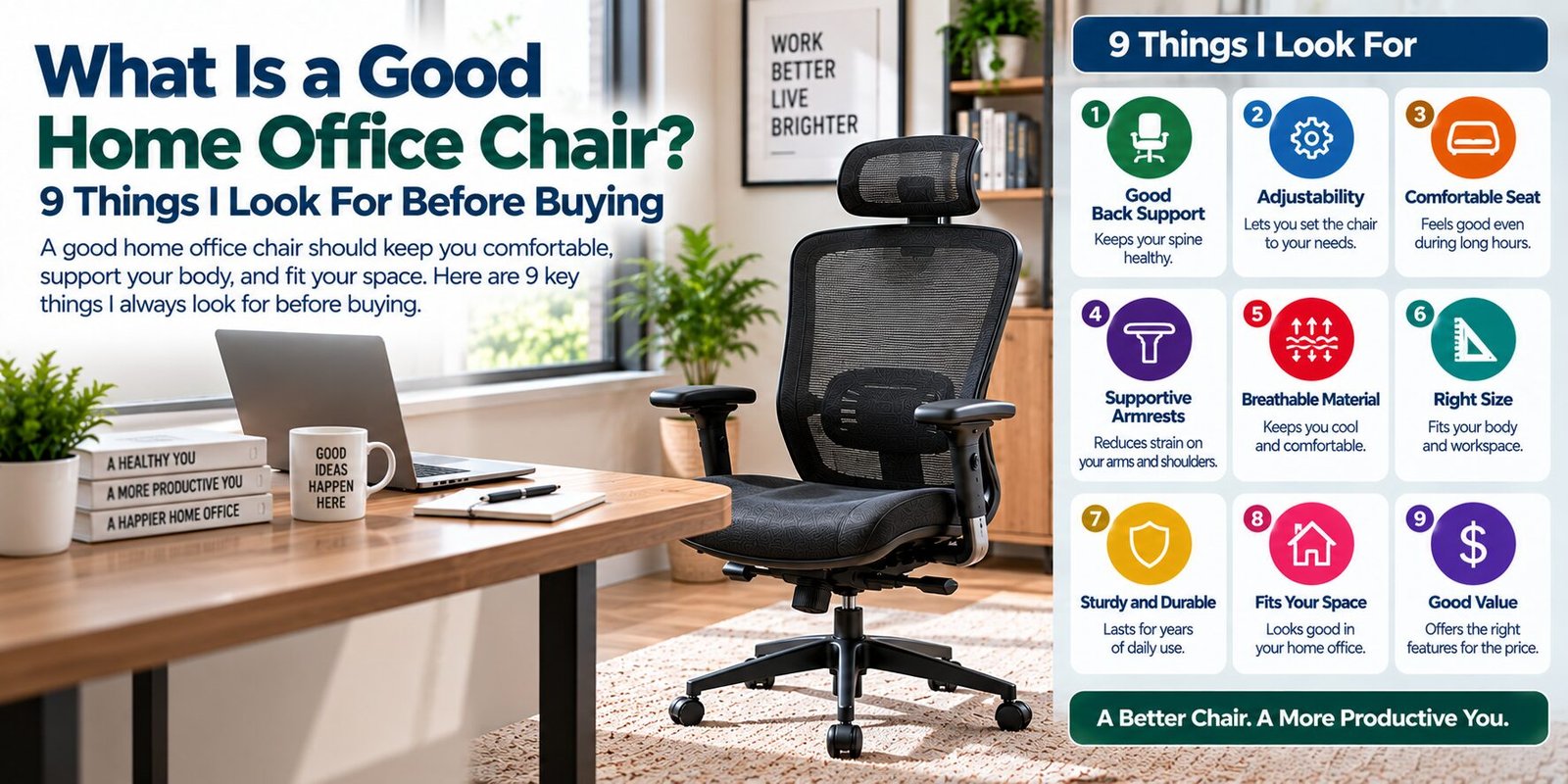
Working from home sounds easy until your chair starts to hurt your back. A good home office chair should feel comfortable, support your body, and fit your desk. It should also let you sit and move without feeling stuck.
When I look at a home office chair, I do not focus on looks alone. I look at the seat, back support, height, armrests, and adjustability. Small details can make a big difference during a long workday.
So, what is a good home office chair? The short answer is a chair that supports your body well, fits your desk, and stays comfortable for the amount of time you use it.
What Is a Good Home Office Chair?
A good home office chair has proper support, useful adjustments, and a seat that fits your body. It should help you keep a natural sitting position without putting too much pressure on your back or legs.
The best chair is not always the most expensive one. A simple chair with good support can work better for you than a large chair with many features.
I also think your work style matters. Someone who sits for eight hours needs different support from someone who uses a desk for one or two hours each day.
What Makes a Home Office Chair Good?
Several parts work together to make a chair comfortable and useful. I would check these areas before making a choice.
1. Good Seat Height
Your chair should let your feet rest flat on the floor. Your knees should sit at a comfortable angle, and your thighs should not feel squeezed.
An adjustable seat height makes this much easier. It also helps you match the chair to your desk.
If the chair is too high, your feet may hang or you may feel pressure under your thighs. If it is too low, your knees may sit too high.
2. Comfortable Seat Depth
Seat depth is easy to overlook. It is the distance from the front of the seat to the backrest.
A seat that is too deep can make it hard to sit back and use the backrest. A seat that is too short may not support enough of your thighs.
The goal is simple. You want enough seat support without the front edge pressing into the backs of your knees.
3. Supportive Backrest
A good backrest should support your back without forcing you into one stiff position.
Look for a backrest that follows the natural shape of your back. Lower-back support can also be useful if you spend many hours at your desk.
I prefer a chair that lets me change my position from time to time. Sitting in one exact position all day is not very practical.
4. Useful Armrests
Armrests can take some load off your shoulders and arms. But they need to be at the right height.
If they are too high, your shoulders may stay raised. If they are too low, they may not provide much support.
Adjustable armrests give you more control. They can also make it easier to position your arms while typing or using a mouse.
Why Adjustability Matters
A chair may look great, but fixed features can be a problem. People have different heights, body shapes, desks, and work habits.
That is why I give extra attention to adjustment options.
Useful adjustments may include:
| Chair Feature | Why It Matters |
|---|---|
| Seat height | Helps match the chair to your desk and leg position |
| Seat depth | Helps support your thighs without knee pressure |
| Backrest angle | Lets you change your sitting position |
| Lumbar support | Gives extra lower-back support |
| Armrest height | Helps place your arms in a comfortable position |
| Seat tilt | Can make position changes easier |
| Headrest | May add support when leaning back |
You do not need every adjustment. The key is having the adjustments that match how you work.
Mesh vs. Cushioned Home Office Chairs
The seat and back material can change how a chair feels.
Mesh chairs allow more airflow. This can be useful if your office gets warm. Mesh can also give a lighter feel and may dry faster after heat builds up.
Cushioned chairs can feel softer. They may suit people who prefer a padded seat during long work sessions.
Neither option is automatically better. I would choose based on comfort, climate, desk time, and personal preference.
For a warm home office, breathable material may be a major benefit. For a cooler room, a well-padded seat may feel more inviting.
How Long Should a Home Office Chair Be Comfortable?
A good home office chair should stay comfortable for your normal work period. If you work for several hours, comfort should be one of your first concerns.
But a chair alone cannot fix every sitting problem.
I would still change positions, stand up, walk around, and take short breaks. Your body needs movement, even when the chair has good support.
If you notice pain or numbness while sitting, do not assume the chair is the only cause. A poor desk height, monitor position, or work setup may also play a role.
What Size Home Office Chair Should You Get?
Chair size should match your body. A very large chair is not always more comfortable.
Check the seat width, seat depth, backrest height, and weight capacity before buying. These details help you avoid a chair that feels too small or too large.
Your desk also matters.
A chair with tall armrests may not fit under a low desk. A wide chair may also be difficult to use in a small workspace.
For a small home office, I would measure the available space first. It is much easier than trying to make a large chair fit later.
What About Wheels and Chair Bases?
Wheels make it easier to move around your desk. A stable five-point base is common on office chairs and can provide a solid foundation.
The floor type matters too. Some wheels work better on hard floors, while others may be more suitable for carpet.
If your office has hardwood or another hard surface, think about how the chair wheels will interact with it. A floor mat can also help protect the floor and make movement smoother.
Common Home Office Chair Problems
Even a chair with many features can have drawbacks.
One common issue is poor adjustment. A chair may offer several controls, but they are not useful if they are hard to reach or understand.
Another issue is excessive firmness or softness. A seat that feels great for ten minutes may not feel good after several hours.
I also pay attention to stability. A chair should feel secure when I shift my weight or lean back. Unwanted movement can become annoying during daily work.
Noise is another small but important detail. Squeaky wheels, loose parts, or a noisy tilt mechanism can become distracting in a quiet home office.
How to Set Up a Good Home Office Chair
Buying a good chair is only part of the job. You also need to set it up correctly.
Start with the seat height. Adjust it so your feet can rest comfortably on the floor.
Next, adjust the backrest and lumbar support if available. You want support without feeling pushed too far forward.
Then set the armrests. Your shoulders should feel relaxed while your hands reach the keyboard and mouse.
Finally, check your desk and monitor. Your chair may be comfortable, but a poor monitor or keyboard position can still make your work setup uncomfortable.
What I Would Look For Before Buying
When I compare home office chairs, I focus on practical details rather than a long feature list.
First, I check whether the chair can fit my body. Then I look at the main adjustments. After that, I consider the seat material, back support, stability, and available space.
I also think about how many hours I will use it each day.
For short desk sessions, basic comfort may be enough. For long workdays, I would put more value on adjustability and support.
Price matters too. I would rather pay for useful features than for a flashy design or features I will never use.Read moreWhat Is a Good Ergonomic Chair? A Simple Guide to Finding the Right Fit
Tips for Choosing the Right Home Office Chair
Before buying a chair, keep these simple points in mind:
- Measure your desk and office space.
- Check the chair’s seat dimensions.
- Look for adjustable seat height.
- Make sure the seat depth suits your legs.
- Check the backrest and lumbar support.
- Choose armrests that fit your desk.
- Consider mesh if your office gets warm.
- Check the chair’s weight capacity.
- Think about the type of floor you have.
- Focus on features you will actually use.
A chair should work with your whole setup. Do not choose one based on appearance alone.
Who Needs a High-Quality Home Office Chair?
A high-quality chair can be especially useful for people who spend many hours at a desk.
This includes remote workers, students, gamers, freelancers, and anyone who uses a home office every day.
If you only sit at your desk for short periods, you may not need advanced features. A basic chair with good height adjustment and decent support may be enough.
For long work sessions, I would put comfort, fit, and adjustability ahead of style.
FAQs
What is a good home office chair?
A good home office chair supports your back, fits your body, and offers useful adjustments. It should also work well with your desk and daily routine.
Is a firm or soft office chair better?
Neither is best for everyone. A firm chair can feel supportive, while a softer seat may feel more comfortable. The right choice depends on your body and how long you sit.
Should a home office chair have lumbar support?
Lumbar support can help support the lower back while sitting. The important part is that the support feels comfortable and fits your body.
How high should a home office chair be?
Your chair should be high enough for your feet to rest flat on the floor while your legs stay in a comfortable position. Seat height should also work with your desk.
Is a mesh chair good for a home office?
Yes, mesh can be a good choice, especially in a warm room. It allows more airflow than many padded materials, but comfort still depends on the chair design and your personal preference.
Conclusion
So, what is a good home office chair? It is a chair that fits your body, supports your back, works with your desk, and stays comfortable during your normal workday.
I would focus on fit and useful adjustments before style. Seat height, seat depth, back support, armrests, and material all matter.
You do not need the chair with the longest feature list. You need one that works well for your body, your space, and the way you work.