
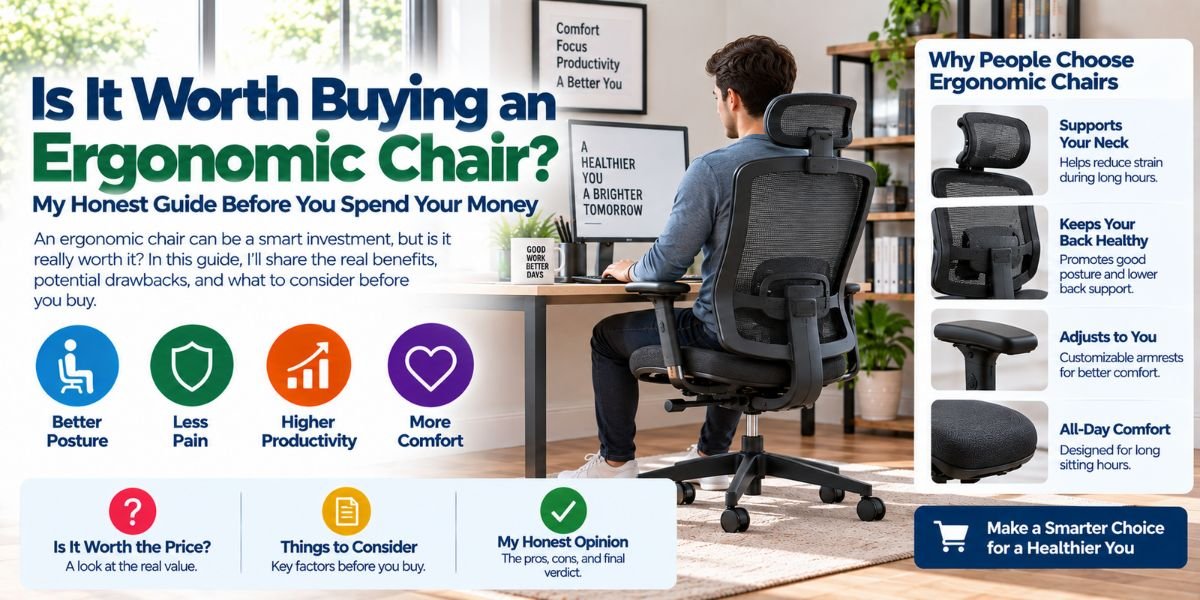
If you sit at a desk for hours, you may wonder, “is it worth buying an ergonomic chair?” I think it can be, but only if you choose the right chair for your body and work style.
An ergonomic chair is not magic. It will not fix every sitting problem. A high price does not always mean better comfort either.
What matters most is fit, support, adjustability, and how you use the chair each day. I would rather buy a well-fitted chair with useful adjustments than an expensive chair that looks great but does not suit me.
So, is an ergonomic chair worth the money? For many people, yes. But there are a few things you should know before buying one.
Is It Worth Buying an Ergonomic Chair?
Yes, an ergonomic chair can be worth buying if you spend several hours sitting each day.
A good ergonomic chair can make long desk sessions feel more comfortable. It can also help you keep a better sitting position. Features like adjustable seat height, lumbar support, armrests, and recline can make a big difference.
But the chair must fit you.
A chair that works well for one person may feel wrong for another. Your height, leg length, desk height, and sitting habits all matter.
For short desk sessions, you may not need an expensive ergonomic chair. If you work, study, game, or create content at a desk for most of the day, the upgrade can make more sense.
What Makes an Ergonomic Chair Different?
An ergonomic chair is designed to support your body while you sit.
The main goal is not simply to make a chair soft. In fact, a very soft chair may not be the best choice for long work sessions.
Instead, an ergonomic chair usually gives you ways to adjust the chair to your body.
Common adjustments include:
- Seat height
- Seat depth
- Lumbar support
- Armrest height
- Backrest angle
- Recline tension
- Headrest position
- Backrest height
These features let you change the chair instead of forcing your body to fit the chair.
That is one of the biggest reasons I see value in ergonomic seating.
Why I Think an Ergonomic Chair Can Be Worth It
The biggest benefit is comfort during long periods of sitting.
When I sit for a long time, small comfort issues become much more noticeable. A seat that feels fine for 20 minutes may feel very different after several hours.
This is where adjustability becomes useful.
I can change the seat height if my feet do not sit well on the floor. I can adjust the armrests so my arms are not hanging too low. I can also change the backrest position when I want to sit more upright or lean back.
A good chair gives me more control over my sitting position.
That does not mean I should sit still all day. I still need to stand, walk, stretch, and change positions.
The Biggest Benefit Is Adjustability
If I had to choose one reason to buy an ergonomic chair, it would be adjustability.
A chair does not need to be packed with 20 features. It needs the right features in the right places.
Seat height is one of the most important adjustments. Your feet should be able to rest comfortably, while your knees and hips stay in a natural position.
Seat depth can also matter. If the seat is too deep, the front edge may press against your legs. If it is too short, you may not get enough support.
Armrests are another useful feature. Properly set armrests can make it easier to keep your shoulders relaxed while using a keyboard or mouse.
Lumbar support can help the lower part of the back feel supported. But too much support can feel just as bad as too little.
Is a More Expensive Ergonomic Chair Better?
Not always.
This is one point I would keep in mind before spending a lot of money.
A $1,000 chair is not automatically twice as good as a $500 chair. Price can reflect materials, build quality, warranty, brand, design, and adjustment options.
But you may not need all of those things.
For me, the better question is not, “How expensive is the chair?”
I would ask, “Does this chair give me the adjustments and support I actually need?”
A mid-range chair with a good fit can be a smarter choice than a premium chair that does not suit your body.
What About Cheap Ergonomic Chairs?
A low-cost ergonomic chair can still be useful.
The problem is that some budget chairs cut costs in areas that matter. The padding may flatten quickly. The adjustment range may be small. The armrests may feel loose. The lumbar support may also be poorly placed.
That does not mean every cheap chair is bad.
It means I would check the actual design instead of trusting the word “ergonomic” on the product page.
Look closely at the adjustment range, seat size, weight capacity, warranty, and return policy.
A chair should also feel stable. If the base or armrests feel weak during normal use, that is a concern.
Ergonomic Chair vs. Regular Office Chair
A regular office chair can be perfectly fine for some people.
If you only sit for short periods, basic padding and a comfortable backrest may be enough.
The difference becomes clearer when you spend much more time at your desk.
An ergonomic chair usually gives you more ways to change the fit. That can be useful when your workday lasts six, eight, or more hours.
Still, I would not assume an ergonomic chair is automatically better.
A well-made regular office chair can beat a poorly designed ergonomic chair. Fit matters more than the label.
| Feature | Basic Office Chair | Ergonomic Chair |
|---|---|---|
| Seat height | Often adjustable | Usually adjustable |
| Lumbar support | Basic or fixed | Often adjustable |
| Armrests | May be fixed | Often adjustable |
| Seat depth | Often fixed | May be adjustable |
| Recline | Basic | Often more adjustable |
| Fit options | Limited | More flexible |
| Long desk sessions | Depends on the chair | Often better suited |
What I Would Check Before Buying
I would never buy an ergonomic chair based only on photos.
First, I would check the seat size.
A chair that is too narrow can feel restrictive. One that is too wide may not give your arms the support you want.
Next, I would look at the seat depth. This is easy to overlook, but it can affect how your legs and back feel.
Then I would check the armrests. Can they move high enough? Can they move low enough? Do they stay in place?
I would also look at lumbar support. Adjustable support is useful, but its shape and position matter too.
Finally, I would check the return policy.
This is especially important when buying online. A chair can look perfect on a screen and feel completely wrong when you sit in it.
Common Problems With Ergonomic Chairs
Ergonomic chairs have drawbacks too.
The first is price. A good chair can cost much more than a basic office chair.
The second is adjustment overload. Some chairs have so many controls that it takes time to find the right setup.
Another problem is the wrong fit.
This is easy to miss. A chair may have excellent features but still feel uncomfortable because the seat, backrest, or lumbar support does not match your body.
I also would not expect an ergonomic chair to solve every sitting problem.
If I sit for eight hours without moving, even the best chair cannot make that a healthy habit.
The chair is only one part of a good desk setup.
Can an Ergonomic Chair Help With Sitting Comfort?
It can improve sitting comfort when the chair is adjusted well.
The key is to set the chair around your body instead of using the factory settings forever.
Start with the seat height. Make sure your feet have solid support.
Then set the backrest so it supports you without forcing you into one stiff position.
Adjust the armrests so your shoulders can stay relaxed.
Finally, set the lumbar support to a level that feels supportive but not aggressive.
Small changes can make a chair feel very different.
Do You Need a Headrest?
Not everyone needs one.
A headrest can be useful if you often recline or like to rest your head during breaks.
But if you mainly sit upright while typing, a headrest may not add much value.
I would not pay a large premium just because a chair has a headrest.
I would first spend money on the adjustments that affect my normal working position.Read moreIs an Ergonomic Chair Worth It? My Honest Guide to Comfort, Support, and Value
Does an Ergonomic Chair Improve Productivity?
It can help indirectly.
When a chair feels uncomfortable, I am more likely to shift around, take extra breaks, or think about the discomfort instead of my work.
A comfortable setup can make long work sessions easier to handle.
But I would not say an ergonomic chair automatically makes someone more productive.
Your desk height, monitor position, keyboard, lighting, and work habits also matter.
The chair is part of the whole setup.
When an Ergonomic Chair Is Probably Worth It
I would consider buying one if you:
- Work at a desk most days
- Sit for several hours at a time
- Study for long periods
- Work from home
- Spend many hours gaming
- Notice that your current chair feels uncomfortable
- Need more adjustment options
- Want a chair that can fit your body better
In these cases, the extra cost can make sense.
The longer you use your chair each day, the more important small comfort differences become.
When You May Not Need One
You may not need an expensive ergonomic chair if you only use a desk for short periods.
For example, someone who checks email for 30 minutes a day may get little value from a premium chair.
You also may not need one if your current chair is already comfortable and properly adjusted.
I would not replace a good chair just because another chair has a better marketing label.
Look at your actual needs first.
My Simple Buying Checklist
Before buying an ergonomic chair, I would check these points:
- Does the seat fit my body?
- Can I adjust the seat height?
- Is the seat depth suitable for me?
- Does the backrest support me comfortably?
- Can I adjust the lumbar support?
- Are the armrests useful and stable?
- Can the chair recline?
- Is the weight capacity suitable?
- Does the chair feel stable?
- Is there a good return policy?
- Is the warranty reasonable?
- Does the price match the features I need?
If a chair fails several of these checks, I would keep looking.
How to Get More From an Ergonomic Chair
Buying the chair is only the first step.
Take some time to adjust it.
Do not copy someone else’s exact settings. Your body may need something different.
Keep your feet supported. Keep your work surface at a comfortable height. Place your monitor where you can view it without constantly bending your neck.
Most importantly, move during the day.
Stand up. Walk around. Change your sitting position. Take short breaks.
An ergonomic chair works best as part of a better work setup, not as a replacement for movement.
Is It Worth Spending More on an Ergonomic Chair?
Sometimes.
I would spend more when the extra money buys something I will actually use.
For example, better adjustment range can be valuable. Stronger build quality can matter if I use the chair every day. A better warranty can also reduce the risk of a costly mistake.
But I would not spend more simply for a fancy design or a long list of features.
The best value comes from useful features that solve a real problem.
FAQs
Is it worth buying an ergonomic chair for working from home?
Yes, especially if you work at a desk for several hours each day. A chair with good adjustment options can make your workspace more comfortable.
How much should I spend on an ergonomic chair?
There is no perfect price for everyone. I would focus on fit, useful adjustments, build quality, warranty, and return options before looking at the price alone.
Is an expensive office chair worth it?
It can be, but high price does not guarantee a better fit. A well-made mid-range chair may be a better choice than a premium chair that does not suit your body.
Do ergonomic chairs really make a difference?
They can make a real difference in sitting comfort when they fit and are adjusted correctly. They work best when combined with regular movement and a good desk setup.
What is the most important ergonomic chair feature?
Adjustability is one of the most important features. Seat height, seat depth, armrests, lumbar support, and recline can help you set the chair to your body.
Conclusion
So, is it worth buying an ergonomic chair?
For someone who spends many hours at a desk, I think it often is. The real value is not the word “ergonomic.” It is the ability to get a better fit and more control over your sitting position.
I would focus on comfort, adjustability, build quality, and fit before brand names or fancy features.
And I would remember one simple thing: even the best ergonomic chair is still a chair. Get up, move around, and change position during the day.
That is what makes a desk setup work better for real life.