
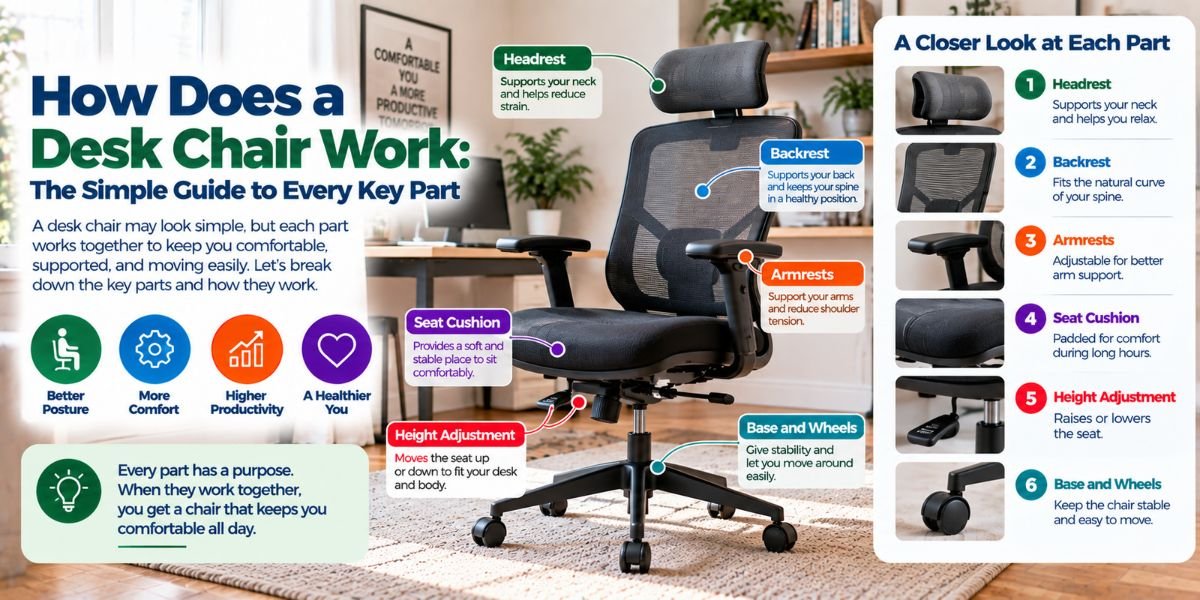
A desk chair looks simple at first. You sit down, move the height lever, and roll across the floor. But many small parts work together to make that possible.
So, how does a desk chair work? A desk chair uses a base, wheels, a gas lift, a seat, and a backrest to support your body and let you move with ease. Other parts control tilt, height, and how far the chair can lean.
I have found that knowing how these parts work makes it much easier to choose, adjust, and care for a desk chair. It also helps explain why one chair feels smooth while another feels stiff or unstable.
How Does a Desk Chair Work?
A desk chair works by combining several mechanical parts into one system. The seat supports your weight. The backrest supports your upper body. The base keeps the chair stable. The wheels let you move.
The height system lets you raise or lower the seat. On many office chairs, this is done with a gas cylinder. A lever controls the cylinder and changes the seat height.
A tilt system adds another type of movement. It lets the chair lean back when you want to change your sitting position.
Each part has a different job. When they work together, the chair can support your body while still allowing movement.
What Are the Main Parts of a Desk Chair?
Most desk chairs have several key parts. Each one affects how the chair feels and moves.
Seat
The seat is the main part that supports your lower body. It spreads your weight across a larger area.
Seat shape matters more than it may seem. A seat that is too short may leave your legs without enough support. A seat that is too deep can make it hard to sit back against the backrest.
Padding also changes the feel. Soft padding can feel cozy at first. Firm padding may give better support during long work sessions.
Backrest
The backrest supports your back while you sit. Some chairs have a fixed backrest. Others can move with you.
A moving backrest can make it easier to change your position. It may follow your body as you lean back or return to an upright position.
The shape of the backrest also matters. A good fit can help you keep a more natural sitting position.
Base
The base sits below the gas cylinder. It usually has several arms that spread outward.
This wide shape helps keep the chair stable. Most modern office chairs use five-star bases because they provide a good mix of balance and movement.
The base also holds the casters. Without it, the chair could not roll or support your weight safely.
Casters
Casters are the small wheels under the chair. They allow the chair to move across the floor.
Different casters work better on different surfaces. Some are made for carpet. Others are designed for hard floors.
If a chair feels hard to move, the casters may be part of the problem. Dirt, hair, or worn wheels can also make movement rough.
Gas Cylinder
The gas cylinder controls the chair’s height. It sits between the base and the seat mechanism.
When you use the height lever, the cylinder allows the seat to move up or down. Once you release the lever, the chair stays at the selected height.
This is why the height lever can feel almost effortless. You are not directly lifting the full chair by hand. The cylinder helps control the movement.
How Does the Height Adjustment Work?
The height adjustment is one of the most useful systems on a desk chair.
When you pull or lift the height lever, you activate the mechanism connected to the gas cylinder. This allows the seat to move.
If there is no weight on the chair, the seat can rise when the cylinder is released. When you sit on the chair, your body weight helps push the seat downward when the mechanism is open.
When you release the lever, the cylinder locks the seat at that position.
This gives you a simple way to set the chair at a comfortable working height.
How Does a Desk Chair Tilt Work?
The tilt system lets the chair lean backward. This can make it easier to change position during work.
A tilt mechanism is usually located below the seat. It connects the seat and backrest to the chair’s base and controls how they move.
Some chairs let the seat and backrest tilt together. Other designs allow the backrest to move more independently.
Many chairs also have tilt tension control. This changes how much force is needed to lean back.
If the tension is too high, the chair may feel hard to recline. If it is too low, the chair may lean back too easily.
The best setting depends on your body weight and how you like to sit.
What Does the Tilt Lock Do?
A tilt lock limits or stops the chair from reclining.
When the lock is engaged, the chair may stay in an upright position. Some chairs offer several lock positions instead of only one.
This can be useful when you want a stable position for typing, reading, or focused desk work.
A chair with a tilt lock gives you more control over how much movement you want.
How Does the Chair Stay Stable?
A desk chair stays stable because several parts work together.
The five-point base spreads the chair’s weight over a wide area. The casters sit at the ends of those points. The center cylinder connects the base to the seat.
Your position also affects stability. Sitting near the center keeps your weight over the base.
Leaning far to one side changes the balance. That is one reason it is important to use the chair as designed.
A strong base and properly fitted parts help the chair feel steady during normal use.
Why Can a Desk Chair Spin?
Many desk chairs can rotate 360 degrees.
The swivel movement comes from the connection between the seat mechanism and the base. A rotating part allows the upper section of the chair to turn while the base and wheels stay in place.
This is useful when you need to reach something beside your desk.
You do not need to move the whole chair every time you turn. You can simply rotate your body and seat together.
How Do Desk Chair Wheels Work?
Chair wheels use small rotating parts to let the chair roll.
When you push the chair, the casters turn and roll across the floor. The caster design affects how easily this happens.
Hard casters can work well on carpet. Softer or floor-friendly casters may be a better choice for hard surfaces.
The floor itself also matters. A rough floor can make even good casters feel less smooth.
If the chair suddenly becomes difficult to roll, check the wheels for hair, dust, and other debris.
What Makes a Desk Chair Comfortable?
Comfort does not come from one part alone. It comes from how the chair fits your body.
The seat should support you without putting too much pressure behind your knees. The backrest should support your back without forcing you into an awkward position.
Height is also important. Your feet should have a stable place to rest while your arms can reach the desk without excessive shoulder strain.
Tilt can add comfort by giving you another sitting position.
In my view, adjustability matters because people do not all have the same body shape or work habits. A chair that fits one person well may feel wrong for another.
How Should I Adjust a Desk Chair?
Start with the seat height.
Raise or lower the chair until your feet can rest firmly on the floor. Then check your desk and arm position.
Next, sit back against the backrest. Adjust the backrest or lumbar support if the chair provides those controls.
Set the tilt tension so reclining feels controlled. If the chair has a tilt lock, choose the position that matches your work style.
Finally, check that you can move the chair without reaching too far or twisting your body.
Small changes can make a large difference.Read moreHow Deep Should a Dining Chair Be: The Comfort Guide Most Buyers Miss
Why Does a Desk Chair Sink Down?
A desk chair that slowly drops can have a problem with its height-adjustment system.
The gas cylinder is designed to hold the seat at the selected height. If the cylinder can no longer maintain that position, the chair may sink while you sit on it.
The lever or height mechanism can also cause trouble if it is not working correctly.
A chair that repeatedly sinks is not something I would ignore. It makes it hard to keep a consistent working height and can be a sign that a part needs repair or replacement.
Why Does a Desk Chair Lean to One Side?
A chair can lean because of uneven parts, a loose connection, a damaged base, or a problem with the mechanism.
Start by checking the simple things. Make sure the base is sitting evenly and that the wheels are properly fitted.
Then check for loose screws or bolts around the seat and mechanism.
If the chair still leans after basic checks, the problem may be inside the mechanism or base. In that case, replacing the damaged part may be safer than continuing to use the chair.
Why Does a Desk Chair Make Noise?
A desk chair can make noises when parts move against each other.
Common causes include loose hardware, dry moving parts, worn casters, or debris around the wheels.
A creak does not always mean the chair is unsafe. Still, a new or worsening sound is worth checking.
I would first inspect the wheels, base, seat connections, and tilt mechanism. Look for anything loose or damaged before adding lubricant or replacing a part.
How Long Can a Desk Chair Last?
The life of a desk chair depends on its design, materials, use, and care.
A chair used for many hours every day faces more wear than one used for short periods.
The casters, gas cylinder, seat foam, armrests, and tilt mechanism can all wear at different rates.
Good care can help. Keep the wheels clean, avoid putting unusual loads on the chair, and check loose hardware from time to time.
A chair does not need to look new to work well. What matters most is whether its main parts still operate properly and safely.
Desk Chair Problems and Simple Fixes
| Problem | Possible cause | What to check |
|---|---|---|
| Chair slowly sinks | Worn height system | Gas cylinder and height lever |
| Wheels do not roll well | Dirt or worn casters | Clean and inspect wheels |
| Chair leans | Loose or damaged parts | Base, bolts, and mechanism |
| Chair will not recline | Tilt lock or tension | Tilt controls |
| Chair feels unstable | Base or caster issue | Five-star base and wheels |
| Chair makes a creak | Loose or dry parts | Moving joints and hardware |
These checks can help you find simple problems. They should not replace proper repair when a major part is damaged.
What Should You Look for in a Desk Chair?
If you are buying a desk chair, start with fit rather than appearance.
Check the seat height range. Make sure it can match your desk and your body.
Look at the seat depth and shape. Then check the backrest and lumbar support.
Next, consider the adjustment options. A chair with height, tilt, and tension controls gives you more ways to find a useful position.
The base and casters also deserve attention. They affect stability and movement.
Finally, think about how you actually work. Someone who sits for long periods may value adjustability more than someone who uses a chair for short tasks.
Frequently Asked Questions
How does a desk chair work?
A desk chair combines a seat, backrest, base, casters, gas cylinder, and adjustment mechanism. These parts work together to support your body, change the chair’s height, and allow movement.
What makes a desk chair go up and down?
The gas cylinder controls the chair’s height. The height lever activates the mechanism, allowing the seat to move up or down until you release the lever.
Why does my desk chair lean back?
The tilt mechanism allows the chair to recline. A tilt lock can limit this movement, while tilt tension controls how much force you need to lean back.
Why does my desk chair keep sinking?
A chair that sinks while you sit may have a worn gas cylinder or a problem with the height mechanism. Checking the cylinder and adjustment lever can help identify the cause.
Why do desk chairs have five wheels?
Five wheels give the chair a broad and stable base. They also spread the load and make it easier to move the chair in different directions.
Conclusion
A desk chair works through a group of simple parts that each have a clear job. The seat supports you, the backrest supports your back, the gas cylinder controls height, the tilt mechanism controls reclining, and the casters provide movement.
Once you understand these parts, a desk chair becomes much easier to adjust and maintain.
The biggest lesson is simple: a good desk chair should support your body while still letting you move. The right fit, useful adjustments, and a stable base matter more than a chair that simply looks impressive.