
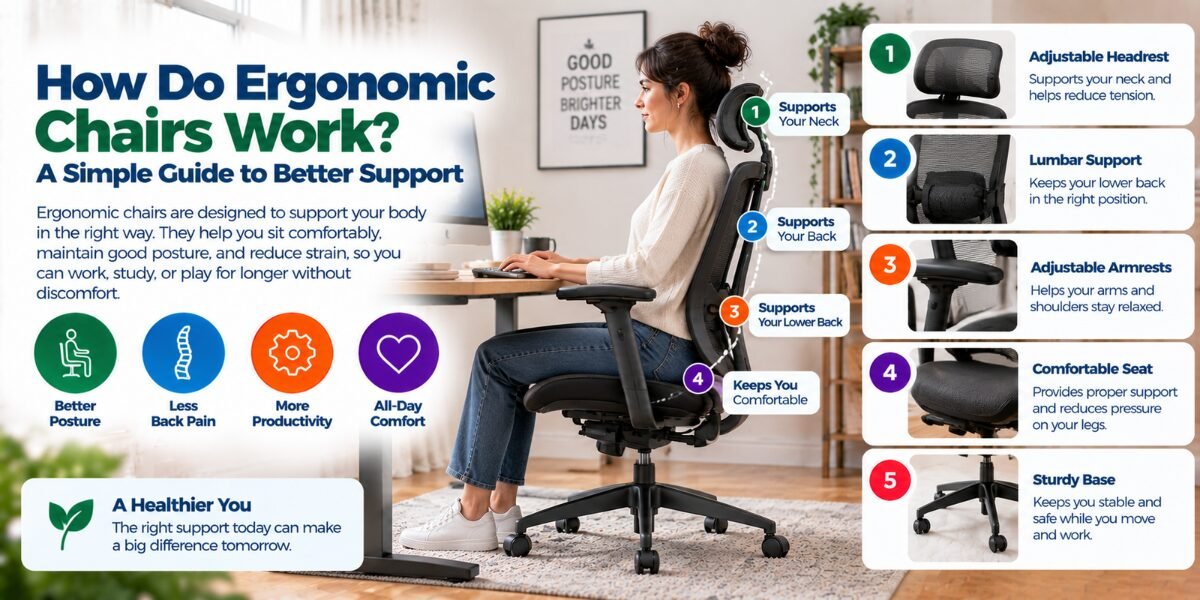
If you sit at a desk for hours, you may wonder how ergonomic chairs actually work. They are not just chairs with extra knobs and levers. Their main goal is to support your body while you sit and help you keep a more natural sitting position.
An ergonomic chair works by letting you adjust key parts of the chair to fit your body. These parts can include the seat height, backrest, armrests, lumbar support, and seat depth. When the settings are right, the chair can reduce pressure on some areas and make long sitting feel more comfortable.
I think the biggest benefit is simple: the chair can adapt to you instead of forcing you to adapt to it.
How Do Ergonomic Chairs Work?
Ergonomic chairs work by supporting your body in a balanced sitting position. They use adjustable parts to help your back, hips, legs, neck, and arms stay in a comfortable position.
A good ergonomic chair does not hold every person in one fixed pose. Instead, it gives you ways to change the chair based on your height, body shape, desk, and work style.
For example, you may raise the seat so your feet rest flat on the floor. You can then adjust the backrest so it supports your back. The armrests can help keep your arms in a relaxed position while you type.
The goal is not perfect posture all day. The goal is better support and easier movement while you work.
What Makes an Ergonomic Chair Different?
A basic office chair may give you a place to sit. An ergonomic chair goes further by offering support and adjustment.
This matters because people are not all the same size. A chair that feels great for one person may feel too deep, too high, or poorly supported for another.
Ergonomic chairs often let you adjust several parts, such as:
- Seat height
- Seat depth
- Backrest angle
- Lumbar support
- Armrest height
- Armrest position
- Headrest position
- Recline tension
- Recline range
Not every ergonomic chair has all of these features. Some simple models only offer a few adjustments.
How Does Seat Height Work?
Seat height is one of the first things I would adjust on an ergonomic chair.
Your feet should be able to rest comfortably on the floor. Your knees should also stay in a natural position. If the seat is too high, your feet may not sit well on the floor. If it is too low, your legs and hips may not feel well supported.
A height-adjustable seat uses a gas lift or another height mechanism to move the seat up and down.
The right height also depends on your desk. You want your chair, arms, and work surface to work together rather than adjusting only the chair.
How Does Lumbar Support Work?
Lumbar support is designed to support the lower part of your back.
The lower back has a natural inward curve. A chair with lumbar support can fill some of the space behind this area. This can help you feel more supported when sitting.
Some chairs have fixed lumbar support. Others let you move it up or down. More advanced models may also let you change how much support you feel.
I find this adjustment useful because lower-back support is not the same for everyone. A support point that feels good for one person may feel too high or too strong for another.
How Does the Backrest Help?
The backrest supports your back while you sit. It can also let you lean back instead of staying upright in one fixed position.
Many ergonomic chairs have a reclining mechanism. When you lean back, the backrest moves with you. Some chairs also let you lock the backrest at certain angles.
A moving backrest can be useful during a long work session. You do not have to keep your body in exactly the same position.
This is important because sitting still for too long can be tiring, even when the chair is comfortable.
How Do Armrests Work?
Armrests support your arms while you work, read, or rest.
Adjustable armrests can help place your elbows and forearms in a more comfortable position. This may reduce the need to hold your arms up without support.
Some armrests move only up and down. Others can move forward, backward, inward, or outward.
The best setting depends on your desk and keyboard. Your shoulders should not have to stay raised just to reach the armrests.
What Is Seat Depth Adjustment?
Seat depth controls how far the seat extends from the front to the back.
This small feature can make a big difference for comfort.
If a seat is too deep, a shorter person may not be able to sit back while keeping a comfortable position for the legs. If it is too short, a taller person may not get enough support under the thighs.
An adjustable seat depth lets you change the usable sitting area.
This is one reason I would not judge an ergonomic chair by padding alone. How the seat fits your body matters just as much.
How Does the Recline Mechanism Work?
The recline mechanism controls how the chair moves when you lean back.
A common system allows the backrest to tilt backward. Some chairs let the seat move with the backrest. Others keep the seat mostly fixed while the backrest reclines.
Many chairs also have tension control. This changes how much force you need to use to lean back.
A lighter tension setting may make reclining easier. A stronger setting may give you more resistance.
The right setting is based on your body weight and how you like to sit.
Why Is Movement Important in an Ergonomic Chair?
One thing that is easy to miss is movement.
An ergonomic chair is not meant to make you sit like a statue. A useful chair lets you change positions during the day.
You may sit upright while typing. Later, you may lean back while reading. You may move closer to your desk for detailed work and then recline during a break.
This ability to move can make long desk sessions feel less rigid.
So, when I think about ergonomic design, I do not look only at how well a chair supports the body in one position. I also look at how easily it allows natural changes in position.
Does an Ergonomic Chair Fix Bad Posture?
No. An ergonomic chair cannot automatically fix your posture.
It can make a better sitting position easier by giving your body useful support. But you still need to set the chair correctly and change positions during the day.
Your desk, monitor, keyboard, and mouse also matter.
For example, a great chair cannot solve every problem if your monitor is placed too low or your keyboard forces your arms into an awkward position.
Ergonomics works best as a complete setup.Read moreHow Do Desk Chairs Work? The Simple Guide to Every Key Part
What Should You Adjust First?
If you buy an ergonomic chair, do not adjust every control at once. Start with the basics.
| Chair Feature | Main Purpose |
|---|---|
| Seat height | Helps your feet and legs sit comfortably |
| Seat depth | Helps the seat fit your leg length |
| Lumbar support | Supports the lower back |
| Backrest | Supports the back and allows movement |
| Armrests | Supports the arms |
| Recline tension | Controls how easily you lean back |
Start with seat height. Then adjust seat depth and back support. After that, set the armrests and recline controls.
Small changes can make a big difference.
Common Ergonomic Chair Problems
Even a well-designed ergonomic chair can feel uncomfortable when the settings are wrong.
A common problem is setting the chair too high. This can leave the feet without enough support.
Another issue is using too much lumbar support. More support is not always better. If the support pushes too hard into your lower back, the chair may feel worse.
Armrests can also cause trouble. If they are too high, your shoulders may stay lifted. If they are too low, they may not provide useful support.
Seat depth is another easy one to overlook. A deep seat can feel comfortable at first but may not work well for a smaller person.
How I Would Set Up an Ergonomic Chair
I would start with my feet flat on the floor and adjust the seat height from there.
Next, I would sit fully back and set the lumbar support so it meets the lower back without feeling aggressive. Then I would check the seat depth and make sure the front of the seat does not create uncomfortable pressure behind the knees.
After that, I would adjust the armrests while keeping my shoulders relaxed.
Finally, I would set the recline tension so I can lean back without fighting the chair.
The key is to test each adjustment while sitting normally. A setting that looks right may not feel right.
Are Ergonomic Chairs Worth It?
For people who spend many hours at a desk, an ergonomic chair can be worth considering.
The main value is not the word “ergonomic” on the product label. It is the ability to create a better fit for your body and work setup.
A basic chair with useful adjustments may work better for you than an expensive chair with features you never use.
I would focus on adjustability, support, comfort, build quality, and fit before worrying about how many controls a chair has.
Who Can Benefit From an Ergonomic Chair?
An ergonomic chair can be useful for many desk users, including:
- Remote workers
- Office workers
- Students
- Gamers
- Writers
- Programmers
- Designers
- People who spend long periods at a computer
The most important factor is how much time you spend sitting and whether your current chair gives you enough support.
If you only sit for short periods, you may not need a chair with many adjustments. For long work sessions, those adjustments can become much more useful.
FAQs
How do ergonomic chairs work?
Ergonomic chairs work by supporting your body and allowing key parts to be adjusted. You can change the chair to better fit your body, desk, and work habits.
What is the most important ergonomic chair adjustment?
Seat height is a good place to start. Your feet should rest comfortably on the floor, while the chair and desk allow you to work without raising your shoulders.
Does lumbar support really help?
Lumbar support can help support the natural curve of your lower back. The right amount varies by person, so it should feel supportive rather than forceful.
Should an ergonomic chair recline?
A reclining backrest can be useful because it lets you change your sitting position. Movement can make long periods at a desk feel less rigid.
Can an ergonomic chair improve posture?
An ergonomic chair can make a supported sitting position easier, but it cannot fix posture by itself. Your desk setup, screen position, work habits, and regular movement also matter.
Conclusion
So, how do ergonomic chairs work? They work by giving your body support while letting you adjust the chair to fit you.
The most useful features are often simple ones: seat height, seat depth, lumbar support, armrests, and a backrest that lets you move. The right setup should feel supportive without forcing your body into one stiff position.
For me, the biggest lesson is that an ergonomic chair is not about finding one perfect sitting pose. It is about creating a setup that supports movement, comfort, and better alignment throughout the workday.