
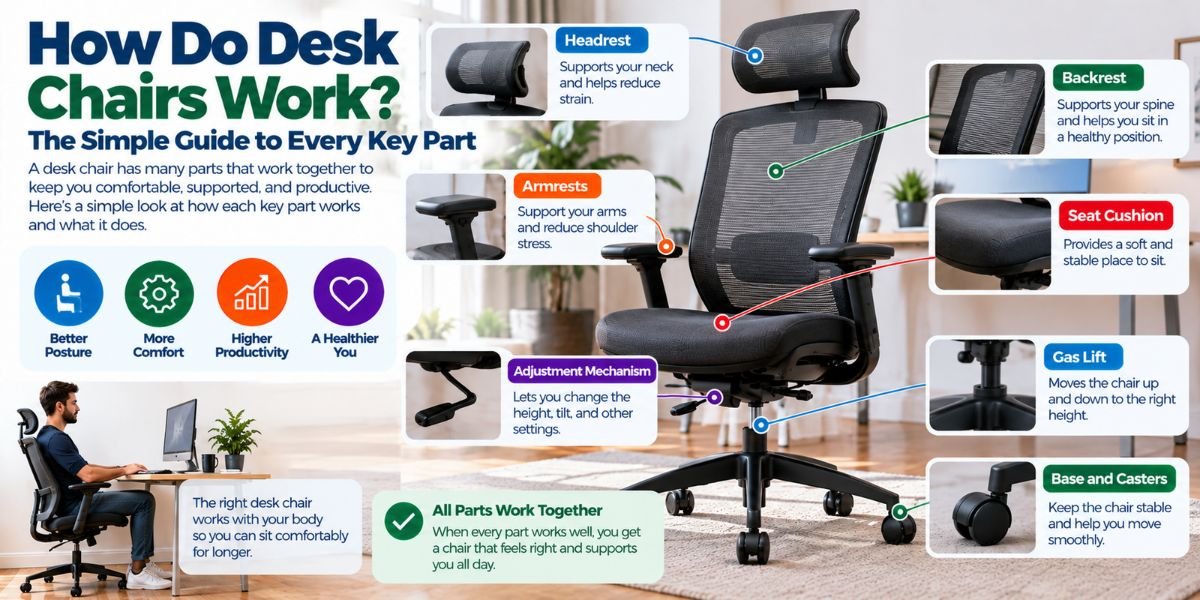
If you have ever leaned back in a desk chair and wondered what makes it move, you are not alone. A desk chair may look simple, but several small parts work together to control height, tilt, support, and movement.
I find desk chairs much easier to understand once you know what each part does. The gas lift changes the height. The tilt system controls how the chair leans. The base keeps it stable. The casters help it roll. The backrest and seat support your body while you work.
In this guide, I will explain how desk chairs work in simple terms. I will also cover the main parts, common problems, adjustments, and what to look for when choosing a chair.
How Do Desk Chairs Work?
Desk chairs work by using a group of mechanical parts that control height, movement, balance, and support. Most office chairs use a gas lift for height adjustment, a tilt mechanism for reclining, and a five-star base with casters for movement.
Each part has a different job.
When you pull the height lever, the gas lift lets the seat move up or down. When you lean back, the tilt mechanism controls the backrest and seat. When you move across the floor, the casters roll under the base.
The parts are simple on their own. Together, they make the chair flexible and comfortable for desk work.
What Are the Main Parts of a Desk Chair?
A typical desk chair has several key parts. You do not need to be a repair expert to understand them.
Seat
The seat is where you sit. It supports most of your body weight while you work.
A good seat should give your legs enough room and let you sit with your feet flat on the floor. Some seats also have a sliding feature. This lets you move the seat forward or backward.
Backrest
The backrest supports your back while you sit.
Some desk chairs have a fixed backrest. Others let you change the angle. A few models also have adjustable lumbar support.
The goal is simple. Your backrest should support you without forcing you into an awkward position.
Armrests
Armrests support your arms and can reduce strain while you type or use a mouse.
Many chairs let you adjust the armrests. Depending on the design, they may move up, down, forward, backward, or sideways.
Gas Lift Cylinder
The gas lift is one of the most important parts of a desk chair.
It is the cylinder under the seat. It uses compressed gas to help raise and lower the chair.
When you lift the height lever, the cylinder releases its internal pressure system. Your body weight can then help move the seat down. When the chair is unloaded, the cylinder can push the seat upward.
This is why your chair can rise smoothly instead of needing a manual screw or pin.
Tilt Mechanism
The tilt mechanism controls how the chair moves when you lean back.
Depending on the chair, it may let you:
- Recline backward
- Lock the backrest in one position
- Adjust how easily the chair tilts
- Let the seat and back move together
This part is especially useful if you change positions during a long work session.
Base
Most desk chairs use a five-star base.
The wide shape spreads the chair’s load and helps keep it stable. Each arm of the base connects to a caster.
The base also connects to the gas lift cylinder. So it plays a key role in holding the entire chair together.
Casters
Casters are the small wheels under the chair.
They allow you to move across the floor without lifting the chair. Some casters are made for hard floors, while others work better on carpet.
A clean and suitable caster can make a big difference in how easily the chair moves.
How Does the Height Adjustment Work?
The height lever controls the gas lift cylinder.
When you pull the lever, the cylinder allows the seat to move. If you are sitting in the chair, your weight usually pushes the seat downward. If you remove your weight, the gas lift can raise the seat.
This creates a simple up-and-down system.
I think of it as a controlled spring-like action. The gas cylinder stores pressure and uses that pressure to help move the seat.
The lever itself does not lift the chair. It simply controls the valve that allows the gas lift to change position.
How Does a Desk Chair Recline?
A desk chair reclines through its tilt mechanism.
When you lean back, your body creates force against the backrest. The mechanism allows the chair to move backward instead of staying completely rigid.
Some chairs have a tilt lock. This lets you stop the chair at a chosen angle.
Other chairs use free tilt. In this setup, the chair can move backward and return toward its normal position as you shift your body.
A tension control may also change how hard you need to push to recline.
What Does Tilt Tension Do?
Tilt tension controls how easily the chair reclines.
If the tension is too high, you may need to push hard with your back. If it is too low, the chair may lean back with very little effort.
A tension knob usually sits under the seat.
Turning it one way makes reclining harder. Turning it the other way makes reclining easier.
The exact direction can vary by chair, so I always check the chair’s instructions before making a big adjustment.
How Does the Chair Stay Upright?
A desk chair stays upright through its base, casters, gas lift, and tilt mechanism.
The five-star base gives the chair a wide footprint. This spreads the load around the center.
The gas lift sits near the middle of the base. The seat and backrest are connected above it.
When you sit normally, your weight is carried through the seat, lift, and base. The wide base helps prevent the chair from tipping during normal use.
That is one reason five-wheel bases are so common on office chairs.
How Do Desk Chair Wheels Work?
Desk chair wheels use small caster assemblies that rotate as you move.
A caster can roll forward and backward. It can also swivel from side to side. This allows the chair to change direction without lifting the base.
The floor matters too.
A chair that rolls well on carpet may feel different on hardwood or tile. Dirt, hair, and dust can also collect around the wheels and make them harder to move.
If your chair suddenly feels rough, checking the casters is a good first step.
How Does Lumbar Support Work?
Lumbar support is designed to support the lower part of your back.
Some chairs use a simple built-in curve. Others use an adjustable pad or support system.
The height and depth of adjustable lumbar support can change how it feels against your back.
I would not assume that stronger support is always better. Too much pressure can feel uncomfortable. The useful setting is the one that supports you without making you feel pushed forward.
Why Does a Desk Chair Rock?
A chair can rock because its tilt mechanism allows movement.
Some chairs are designed to rock freely. Others have a tilt lock that keeps the chair in a fixed position.
A tension control affects the amount of effort needed to create this movement.
If the chair rocks when you do not want it to, first check whether the tilt lock is released. If the chair still feels loose or unstable, the mechanism may need inspection.
A normal tilt motion should feel controlled. It should not feel like the chair is about to collapse.
Why Does My Desk Chair Keep Sinking?
A desk chair that slowly sinks often has a worn gas lift cylinder.
The cylinder is designed to hold the seat at a set height. With age or wear, it may no longer maintain that position.
You may notice that the chair starts at the correct height but slowly drops while you sit.
If this happens often, adjusting the lever will not usually solve the root problem. The gas lift itself may need replacement.
Before replacing anything, make sure the height lever is not stuck or being pressed by another part under the seat.Read moreHow Deep Is a Dining Chair? A Simple Size Guide for Comfort and Space
Why Is My Desk Chair Leaning to One Side?
A desk chair can lean because of several issues.
The problem may come from:
- A loose base
- A damaged caster
- Uneven flooring
- A worn tilt mechanism
- Loose screws
- A damaged seat connection
I would first check the simple things. Look at the wheels and base. Then check whether the main bolts and screws are tight.
If the frame itself is bent or cracked, continued use may not be safe.
How Do You Adjust a Desk Chair Correctly?
Start with the seat height.
Your feet should rest comfortably on the floor. Your knees should not feel forced into an awkward position.
Next, adjust the backrest and lumbar support if your chair has those features.
Then set the armrests so your shoulders can stay relaxed while you work.
Finally, adjust the tilt tension. The chair should recline when you want it to, but it should not move too easily.
Small changes can make a chair feel very different. I prefer to adjust one feature at a time rather than changing everything at once.
Desk Chair Parts and Their Jobs
| Chair Part | Main Job |
|---|---|
| Seat | Supports your body |
| Backrest | Supports your back |
| Armrests | Supports your arms |
| Gas lift | Adjusts seat height |
| Tilt mechanism | Controls reclining |
| Tension control | Changes reclining resistance |
| Base | Provides stability |
| Casters | Let the chair roll |
| Lumbar support | Supports the lower back |
What Makes a Desk Chair Comfortable?
Comfort is not controlled by one part.
The seat affects how your legs and hips feel. The backrest affects your back. Armrests affect your shoulders and arms. The tilt system affects how easily you can change position.
Chair size matters too.
A chair that is too small may feel cramped. A chair that is too large may make it hard to use the armrests or sit with good support.
For me, the best setup is one where I can sit naturally without constantly adjusting my body to fit the chair.
Common Desk Chair Problems
Desk chairs can develop small problems over time.
A chair may squeak. A wheel may stop rolling well. The height may stop holding. The tilt may feel loose. A screw may become loose after long use.
Not every problem means the chair is finished.
Simple cleaning and tightening can solve some issues. A damaged caster can often be replaced. A worn gas cylinder can also be replaced on many chair designs.
But structural damage is different. A cracked base, damaged frame, or badly bent part should not be ignored.
How Long Do Desk Chairs Last?
There is no single lifespan for every desk chair.
How long a chair lasts depends on its build, materials, use, user weight, maintenance, and daily workload.
A chair used for a few hours each week may experience much less wear than one used every workday.
The parts that move often tend to show wear first. Casters, tilt mechanisms, armrests, and gas lifts can all become less reliable over time.
Regular cleaning and occasional checks can help you spot problems early.
Tips for Getting More From Your Desk Chair
A few simple habits can help.
Keep the wheels clean. Dust and hair can build up around caster parts.
Check loose screws from time to time. A small amount of movement can become a bigger problem if ignored.
Avoid using the chair as a step stool. The base and casters are designed for sitting and rolling, not climbing.
Also, do not force an adjustment lever. If a control suddenly becomes hard to move, stop and check what is causing the problem.
A little care can help keep the chair working smoothly.
FAQs About How Desk Chairs Work
How does a desk chair go up and down?
Most desk chairs use a pneumatic gas lift cylinder. The height lever opens a valve, allowing the cylinder to raise or lower the seat.
Why does my office chair slowly sink?
A sinking chair often has a worn gas lift cylinder. If the seat drops while you sit, the cylinder may no longer be holding pressure properly.
How does a desk chair recline?
A tilt mechanism connects the seat and backrest and allows controlled backward movement. A lock and tension control may let you change how the reclining action feels.
Why does my desk chair wobble?
A loose screw, damaged caster, uneven floor, worn mechanism, or damaged base can cause wobbling. Check the wheels and connections before using the chair further.
What is the knob under my desk chair for?
It may control tilt tension. Turning the knob changes how much force is needed to lean the chair backward, although the exact control can vary by model.
Conclusion
So, how do desk chairs work? They use several simple mechanical systems that work together.
The gas lift handles height. The tilt mechanism controls reclining. The base provides stability. Casters allow movement. The seat, backrest, armrests, and lumbar support help you stay supported while working.
Once you understand these parts, choosing and adjusting a desk chair becomes much easier. You can also spot common problems faster and know which part may need attention.
The key is not to look at a desk chair as one complicated object. Think of it as a group of small systems working together to make sitting, moving, and changing position easier.