
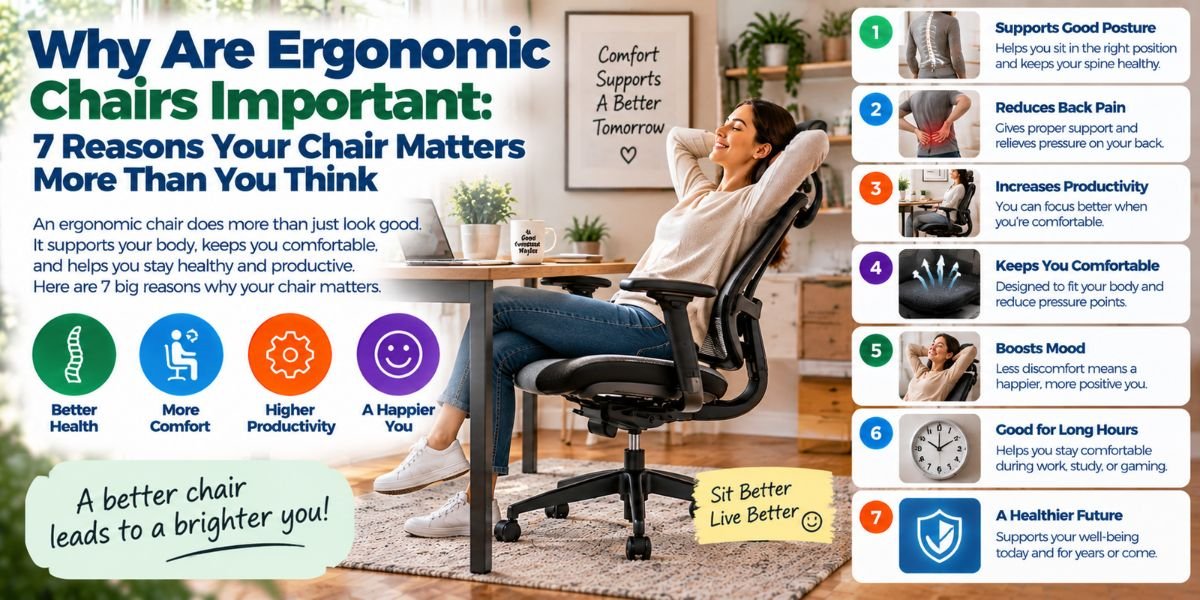
If you sit for hours each day, your chair matters more than you may think. A poor chair can make long work sessions feel tiring. It may also make it harder to keep a good sitting position.
So, why are ergonomic chairs important? An ergonomic chair is made to support your body while you sit. It can help you keep a more natural posture, adjust the chair to your body, and reduce some of the strain that comes with long periods of sitting.
I think the biggest benefit is simple. A good ergonomic chair helps your chair fit you, rather than forcing your body to fit the chair.
Why Are Ergonomic Chairs Important?
Ergonomic chairs are important because they are designed around the needs of the person sitting in them. Many parts can be adjusted to give better support.
These parts may include the seat height, backrest, armrests, headrest, and lumbar support. The exact features vary by chair.
A regular chair may work fine for a short meal or quick task. But sitting at a desk for several hours is different. Small comfort problems can become much more noticeable over time.
An ergonomic chair gives you more control over your sitting setup. That can make your desk feel more comfortable and easier to use.
They Can Help Support Better Posture
One major reason ergonomic chairs are popular is posture support.
When a chair does not fit well, you may lean forward, slump, or move into awkward positions without noticing. This can happen when the seat is too high, too low, too deep, or poorly supported.
An adjustable chair gives you more ways to find a comfortable sitting position.
Good posture does not mean sitting stiff like a statue. You should still move. The goal is to keep your body in a comfortable and supported position while you work.
A chair can help with this by supporting your lower back and keeping your body better aligned with your desk.
They Can Make Long Work Sessions More Comfortable
Sitting for a long time can become uncomfortable even when you have a good chair.
That is why I would not view an ergonomic chair as a magic fix. It cannot make sitting all day healthy by itself.
What it can do is improve the comfort of your sitting setup.
A well-designed seat can reduce pressure points. Adjustable support can also help you find a position that feels better for your body.
This matters if you work from home, study, play games, or spend many hours at a computer.
Adjustable Features Let You Fit the Chair to Your Body
People are not all the same size. A chair that feels great for one person may feel wrong for another.
This is where adjustability becomes useful.
Seat height is one of the most important adjustments. Your feet should be able to rest comfortably on the floor or on a suitable footrest. Your knees should also be in a comfortable position.
Armrests can help support your arms when they are adjusted correctly. A backrest can provide support while still allowing you to move.
Some chairs also offer adjustable seat depth. This can be helpful because people have different leg lengths.
The more useful adjustments a chair has, the easier it can be to create a setup that suits your body.
Lumbar Support Can Support Your Lower Back
The lower back is another reason ergonomic chair design matters.
Many ergonomic chairs include lumbar support. This support is designed to fit the natural curve of your lower back.
A chair with poor back support may leave you feeling like you need to hold yourself upright all the time.
With suitable lumbar support, the backrest can provide some of that support for you.
However, more support is not always better. A large, hard lumbar pad may feel uncomfortable if it does not match your body.
The best setup is one that feels supportive without pushing your back into an unnatural position.
They Can Help You Keep Your Arms in a Better Position
Your arms also matter when you work at a desk.
If your chair is too low or your desk is too high, you may raise your shoulders while using your keyboard or mouse. That can make your upper body feel tense.
Adjustable armrests can help you find a more comfortable arm position.
The goal is not to keep your arms locked in one place. You should be able to use your keyboard and mouse without constantly lifting your shoulders.
Your chair, desk, keyboard, and monitor should work together as one setup.
They Can Improve Your Overall Desk Setup
A chair does not work alone.
This is one point I think people often miss when choosing an ergonomic chair. You can buy a very adjustable chair and still have an uncomfortable workspace if the desk or monitor is poorly positioned.
Your monitor should be placed so you do not need to keep bending your neck. Your keyboard and mouse should be easy to reach. Your feet should have proper support.
The chair is one part of the whole setup.
When everything works together, it becomes easier to maintain a comfortable working position.
Ergonomic Chairs Can Be Useful for Home Offices
Home workers often spend many hours at a desk. A dining chair or basic office chair may feel fine at first.
The problem can appear after several hours.
A chair that lacks proper adjustments may not give you enough support for a full workday. This can make your home office feel less comfortable.
An ergonomic chair can be a useful upgrade if your current chair causes discomfort or does not let you adjust your sitting position.
You do not always need the most expensive chair, either. The important thing is whether the chair has useful adjustments and fits your body.
They May Help Reduce Pressure From Poor Sitting Habits
An ergonomic chair cannot correct every sitting problem.
Still, a good design can make it easier to avoid some poor sitting positions.
For example, the right seat height can help you keep your feet supported. Proper lumbar support can help support your lower back. Adjustable armrests can help reduce the need to lift your shoulders.
These small changes can make a big difference in how your workspace feels.
But movement is still important. Even with a great chair, it is a good idea to stand up, walk around, and change position during long periods of desk work.
What Makes a Chair Ergonomic?
There is no single feature that automatically makes a chair ergonomic.
Instead, look at how well the chair supports your body and how easily you can adjust it.
Useful features may include:
| Feature | Why It Matters |
|---|---|
| Adjustable seat height | Helps you find a comfortable leg and foot position |
| Lumbar support | Supports the lower back |
| Adjustable armrests | Helps position the arms more comfortably |
| Adjustable seat depth | Can help the seat fit different leg lengths |
| Reclining backrest | Lets you change your sitting position |
| Supportive seat | Helps improve comfort during longer sessions |
| Stable base | Gives the chair a secure feel |
Not every person needs every feature. The best chair is the one that fits your body and your daily use.
Are Expensive Ergonomic Chairs Always Better?
No.
Price can reflect materials, build quality, warranty coverage, and the number of adjustments. But a higher price does not guarantee a better fit for you.
I would pay more attention to adjustability and fit than to the brand name alone.
A chair with many features can still feel wrong if the seat is too deep or the back support is in the wrong place.
Before buying, think about your height, leg length, desk height, daily sitting time, and preferred sitting position.
A simple chair that fits you well can be more useful than a premium chair that does not.
Common Problems With Ergonomic Chairs
Ergonomic chairs have benefits, but they are not perfect.
Some models can take time to adjust. With several controls, it may not be obvious where to start.
Some chairs also have firm seats or strong lumbar support. That may feel strange if you are used to a soft chair.
Another issue is cost. Good ergonomic chairs can be expensive, especially when they use high-quality materials and offer many adjustments.
There is also a learning curve. A chair cannot help much if it is adjusted incorrectly.
Take time to set the chair up for your body instead of using the factory position.
How Should You Set Up an Ergonomic Chair?
Start with the seat height.
Adjust it so your feet can rest comfortably on the floor or a footrest. Your knees should feel relaxed rather than forced into an awkward position.
Next, adjust the backrest and lumbar support. The support should feel natural against your lower back.
Then set the armrests. Your shoulders should feel relaxed while your arms are supported.
Finally, check your desk and monitor.
Your chair may be adjusted perfectly, but the rest of the workstation can still create problems.
Make small changes instead of changing everything at once. This makes it easier to notice which adjustment helps.Read moreWhy Are Ergonomic Chairs Good: 9 Reasons They Can Make Sitting Better
Ergonomic Chair vs. Regular Chair
A regular chair is not automatically bad.
If you sit for short periods, a basic chair may be enough. You may not need a highly adjustable model for occasional use.
An ergonomic chair becomes more useful when you spend many hours at a desk.
The main difference is adjustability and support. A basic chair may offer limited control over your sitting position. An ergonomic chair usually gives you more ways to change the fit.
That extra control is the main reason many people prefer ergonomic chairs for office work.
Who Should Consider an Ergonomic Chair?
An ergonomic chair may make sense if you:
- Work at a desk for several hours each day
- Work from home
- Study for long periods
- Spend a lot of time gaming
- Often feel uncomfortable in your current chair
- Need more control over seat height or back support
- Share a workspace with people of different sizes
You do not need an ergonomic chair simply because everyone recommends one.
Look at your daily routine first. If your current chair feels comfortable and supports you well, there may be no urgent reason to replace it.
How I Would Choose One
If I were choosing an ergonomic chair, I would start with fit rather than looks.
I would check the seat height range first. Then I would look at seat depth, lumbar support, armrest adjustment, backrest movement, and the overall seat feel.
I would also think about how long I sit each day.
For a home office, I would want enough adjustment to make the chair work with my desk. For shorter sessions, I would put less importance on advanced features.
Most importantly, I would not assume that more features always mean more comfort.
FAQs
Why are ergonomic chairs important?
Ergonomic chairs are important because they offer support and adjustments that can help create a more comfortable sitting position. They are especially useful for people who spend many hours at a desk.
Are ergonomic chairs good for sitting all day?
An ergonomic chair can make long sitting periods more comfortable, but it does not make sitting all day ideal. Regular movement, standing, and position changes are still important.
What is the most important feature of an ergonomic chair?
There is no single best feature for everyone. Adjustable seat height, good back support, and a seat that fits your body are strong places to start.
Can an ergonomic chair improve posture?
An ergonomic chair can support a better sitting position when it is adjusted correctly. However, posture also depends on your desk setup, habits, and how often you change position.
Is an expensive ergonomic chair worth it?
Not always. A chair is worth the money when its fit, comfort, build quality, and adjustments match your needs. A cheaper chair can work well if it fits you properly.
Conclusion
So, why are ergonomic chairs important? The main reason is that they give you more control over how you sit.
A good ergonomic chair can support your lower back, help you find a better sitting position, and make long desk sessions more comfortable. It can also work with your desk and monitor to create a better overall workspace.
But the chair is only one part of the picture.
The best results come from a chair that fits your body, a desk that suits your height, a well-placed monitor, and regular movement throughout the day.
If you spend many hours at a desk, choosing a chair based on fit and useful adjustments is usually a smarter move than choosing one based only on looks or price.