
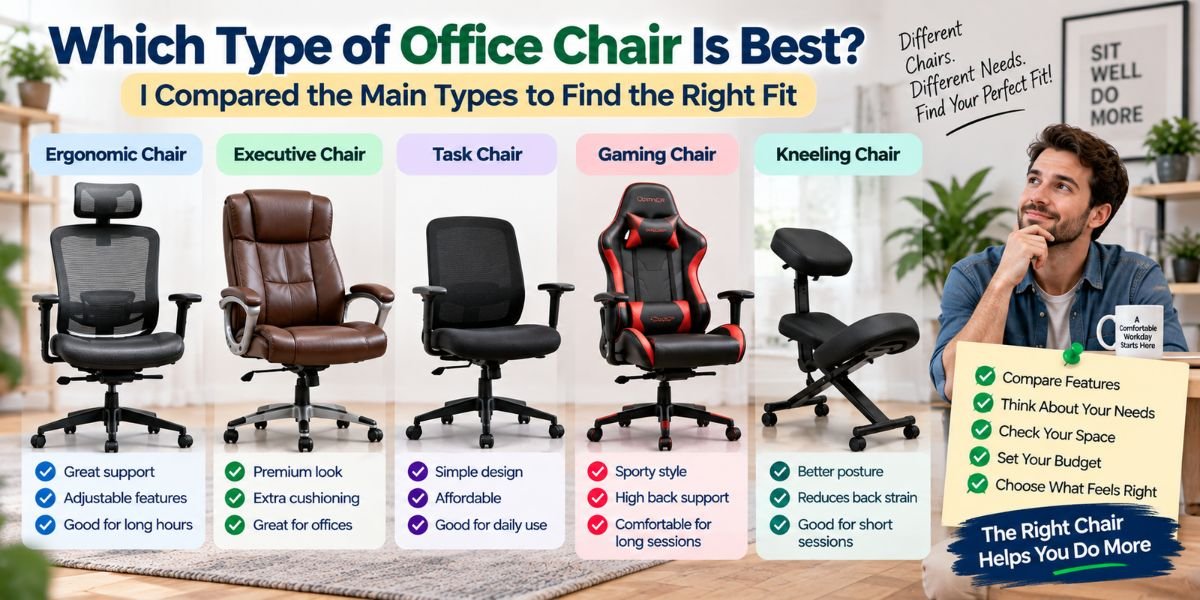
If you sit at a desk for hours, your office chair matters more than you may think. A chair can look great and still feel awful after a long workday.
So, which type of office chair is best?
For most people, an ergonomic office chair is the best choice. It gives better support, lets you adjust the seat and back, and helps you sit in a more natural position. But that does not mean every ergonomic chair is right for everyone.
The best chair depends on how you work, how long you sit, your body size, and what kind of support you like.
I compared the main office chair types to make this choice easier. Here is what I would look for before buying one.
Which Type of Office Chair Is Best?
The best type of office chair for most people is an adjustable ergonomic office chair with good lumbar support, a comfortable seat, adjustable armrests, and a backrest that supports natural movement.
A good ergonomic chair should let you adjust the parts that matter most. Your feet should rest flat on the floor. Your knees should stay near a right angle. Your lower back should have support without feeling pushed too hard.
Still, ergonomic chairs are not the only option.
Task chairs, executive chairs, mesh chairs, kneeling chairs, and saddle chairs can all work well in the right setting. The key is matching the chair to your daily use.
What Makes an Office Chair Good?
I do not judge an office chair by looks alone. A chair can have thick padding and soft leather but still lack useful support.
I pay more attention to adjustability and fit. A chair should allow you to set the seat height, find a comfortable sitting position, and keep your back supported.
The seat is also important. It should give your legs enough room without putting pressure behind your knees.
A chair should also feel stable. If it rocks, slides, or moves too easily when you do not want it to, that can become annoying during long work sessions.
Ergonomic Office Chairs
For regular desk work, an ergonomic office chair is my first choice.
These chairs are made around the way people sit and work. Many offer adjustable lumbar support, seat height, armrests, recline tension, and backrest movement.
That adjustability is the big advantage.
You can change the chair to fit your body instead of trying to fit your body to the chair.
Why I Like Ergonomic Chairs
An ergonomic chair can be useful if you spend many hours at a desk. You can adjust the chair as your sitting needs change during the day.
I also like that many ergonomic chairs support more than one sitting position. You do not have to stay completely upright all day.
The Downsides
Good ergonomic chairs can cost more than simple task chairs.
They can also have many controls. At first, that may feel confusing. A chair with ten adjustments is not automatically better than one with five useful adjustments.
The goal is useful support, not a pile of buttons.
Mesh Office Chairs
Mesh chairs are popular because they allow airflow through the backrest.
This can be a big plus if you work in a warm room or tend to feel hot while sitting. The back can feel less stuffy than a padded chair.
Mesh also gives the chair a lighter look.
When a Mesh Chair Makes Sense
I would consider a mesh chair for long desk work, especially in a warm office. The breathable back can make a real difference over several hours.
But mesh firmness varies. Some mesh backs feel supportive, while others feel too loose.
The seat can also be padded even when the back is made from mesh, so do not assume the whole chair will feel the same as a mesh back.
Task Chairs
Task chairs are built for everyday desk work.
They are often smaller and simpler than large executive chairs. This can make them a smart choice for home offices, small rooms, or shared work areas.
A good task chair does not need to look impressive. It needs to work well.
Best Use for a Task Chair
I would choose a task chair when I want a practical chair that does not take over the room.
They are also useful when you move between tasks often. A compact design can make it easier to reach your desk, keyboard, and other items.
The main thing to check is adjustment. Some basic task chairs offer very little support customization.
Executive Office Chairs
Executive chairs are usually large, padded, and designed to look more luxurious.
They can feel very comfortable at first. The thick seat and high back can make a strong first impression.
But comfort is not the same as good ergonomic support.
A large chair may not fit a smaller person well. The deep seat can also make it harder to sit with your back in the right position.
Who Should Choose One?
An executive chair can make sense if you like a large, cushioned seat and have enough space for it.
I would not choose one only because it looks expensive. For long hours at a computer, support and fit matter more than appearance.
Kneeling Chairs
Kneeling chairs use a very different sitting position.
Instead of placing all your weight on a normal seat, they spread some of it toward your knees and lower legs.
Some people like this position because it can encourage a more open hip angle.
However, I would not treat a kneeling chair as the best choice for everyone.
It can take time to get used to. It may also feel uncomfortable if you need to stay in one position for a long time.
For many people, I would see it as an alternative seating option rather than a replacement for a good ergonomic office chair.
Saddle Chairs
Saddle chairs have a seat shaped more like a saddle.
They allow your legs to drop more naturally instead of keeping them straight in front of you.
This design is more common in certain work settings, such as studios, clinics, and other spaces where users move around frequently.
For a normal computer desk, a saddle chair may not be the first type I would pick.
It can work well for a specific task, but it has a learning curve and needs the right desk height.
What Office Chair Is Best for Long Hours?
For long hours, I would start with an ergonomic chair that has strong adjustability and good lower-back support.
The most important features are not fancy extras. I would look for:
- Adjustable seat height
- Good lumbar support
- A comfortable seat
- Adjustable armrests
- A supportive backrest
- Useful recline movement
- A stable five-point base
- Enough seat depth for your legs
- A design that fits your body
A chair should also let you change position.
Even a good chair is not a reason to sit still for hours. Standing up, walking around, and changing your position can make desk work feel much better.
Which Office Chair Is Best for a Small Home Office?
A compact task chair or smaller ergonomic chair is usually the better fit.
Large executive chairs can take up a surprising amount of space. They may also make a small office feel crowded.
Before buying, measure the space around your desk.
Check the chair’s width, depth, and height. Also think about how far it rolls under the desk.
This small check can save you from buying a chair that looks good online but makes your room hard to use.Read moreWhich Is the Best Ergonomic Office Chair in India? 7 Chairs Worth Considering
Which Office Chair Is Best for Hot Rooms?
A mesh-back office chair is often a good choice for a warm room.
The open material lets air move through the back. This can feel more comfortable than a fully padded backrest.
But I would still check the seat material. A breathable back does not help much if the seat traps heat.
Room temperature matters too. No chair can fully solve an overheated office.
Which Office Chair Is Best for Back Support?
An adjustable ergonomic office chair is usually the best starting point for back support.
Look for lumbar support that fits the curve of your lower back. Adjustable support is useful because people have different body shapes.
Avoid assuming that the hardest or thickest lumbar support is the best.
Too much pressure can feel just as unpleasant as too little. The support should feel steady without forcing your back into one position.
If sitting causes ongoing or severe pain, a chair alone may not solve the problem. In that case, getting advice from a qualified health professional is a better step.
Quick Comparison of Office Chair Types
| Office chair type | Best for | Main advantage | Main drawback |
|---|---|---|---|
| Ergonomic chair | Long desk work | High adjustability | Can cost more |
| Mesh chair | Warm rooms | Better airflow | Mesh feel varies |
| Task chair | Everyday work | Simple and compact | May have fewer adjustments |
| Executive chair | Large offices | Thick padding and high back | Can be bulky |
| Kneeling chair | Alternative sitting | Different sitting position | Takes time to adapt |
| Saddle chair | Specialized tasks | Open hip position | Not ideal for every desk |
How I Would Choose an Office Chair
I would start with my daily routine.
If I work at a computer for most of the day, I would choose an adjustable ergonomic chair. If my room is warm, I would look closely at mesh designs.
If space is tight, I would focus on a compact task or ergonomic chair.
If I want a soft, large chair and have plenty of room, an executive chair may make sense.
I would not buy based on appearance alone. I would check the measurements, adjustments, seat depth, back support, and return policy first.
The chair needs to fit me. Not the other way around.
Common Office Chair Mistakes to Avoid
One common mistake is choosing a chair that is too large.
A deep seat can look comfortable but may leave your feet poorly positioned. A very high back can also feel awkward if it does not match your body.
Another mistake is ignoring the desk.
Your chair and desk work as a pair. Even a great chair can feel wrong if the desk is too high or too low.
I also would not assume that more padding means more comfort. Padding can feel great at first but may not provide the support you need throughout the day.
Finally, do not ignore movement. Sitting perfectly still in the “correct” position all day is not the goal.
FAQs
Which type of office chair is best for most people?
An adjustable ergonomic office chair is the best choice for most people. It can be adjusted for height, support, arm position, and sitting angle.
Is a mesh office chair better than a padded chair?
Not always. Mesh is useful for airflow, while padding can offer a softer feel. Your room temperature, comfort needs, and personal preference should guide the choice.
What type of office chair is best for long hours?
An ergonomic chair with good adjustability is usually the best option. Look for a supportive seat, lumbar support, adjustable arms, and a backrest that allows movement.
Are executive office chairs good for your back?
They can be comfortable, but size and padding do not guarantee good support. A properly adjusted ergonomic chair is often a better choice for long computer sessions.
Should I buy an ergonomic office chair?
If you spend many hours working at a desk, an ergonomic chair is worth considering. Its main benefit is the ability to adjust the chair to your body and work style.
Conclusion
So, which type of office chair is best?
For most people, I would choose an adjustable ergonomic office chair. It offers the best mix of support, movement, comfort, and flexibility for everyday desk work.
A mesh chair can be better for a warm room. A task chair can be better for a small office. An executive chair can suit someone who wants extra padding and has plenty of space.
The best office chair is not the biggest, softest, or most expensive one. It is the chair that fits your body, supports your work, and lets you stay comfortable while changing position throughout the day.