
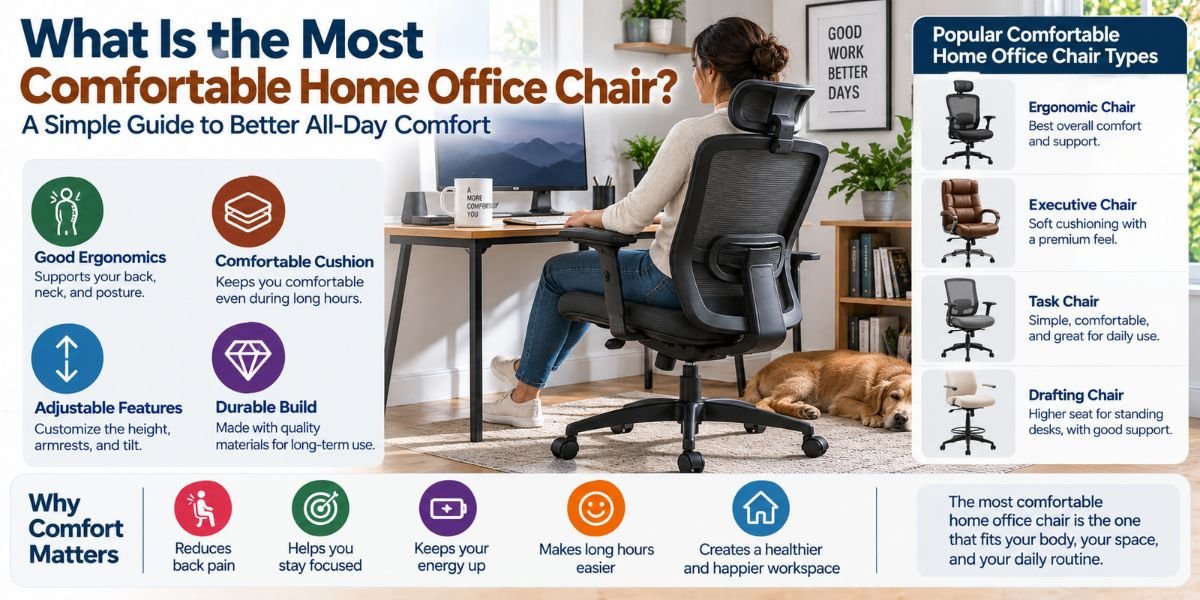
Sitting at a desk for hours can get old fast. A chair that feels good for 10 minutes may feel very different after three or four hours.
So, what is the most comfortable home office chair?
The best choice is not simply the softest chair. For most people, the most comfortable home office chair is one that fits the body well, supports the lower back, lets the seat adjust, and makes it easy to change sitting positions.
I have found that comfort comes down to fit more than looks. A chair can look great and still leave you shifting around all day. The right chair should support you without making you think about the chair.
What Is the Most Comfortable Home Office Chair?
The most comfortable home office chair is usually an ergonomic chair with adjustable seat height, seat depth, lumbar support, armrests, and recline.
It should support your back while letting you move. Your feet should rest firmly on the floor or a footrest. Your shoulders should stay relaxed, and your arms should sit close to your body.
There is no single chair that feels perfect for everyone. Body size, desk height, sitting style, and daily work time all matter.
That is why adjustability is so important. A chair that lets you change its fit has a much better chance of feeling comfortable for long work sessions.
Why Chair Fit Matters More Than Extra Padding
A thick seat may feel very soft when you first sit down. But soft does not always mean comfortable for a full workday.
If the seat is too deep, you may have trouble keeping your back against the backrest. If it is too short, part of your thighs may not get enough support.
The front edge also matters. A rounded or waterfall edge can reduce pressure behind your knees.
I would pay close attention to these details before worrying about fancy extras. A simple chair that fits well can feel better than an expensive chair that does not match your body.
The Most Important Comfort Features
Adjustable Seat Height
Your chair should let you set the seat at a height that works with your desk.
Ideally, your feet should rest flat on the floor. Your legs should feel supported without your knees being pushed into an awkward position.
If the chair is too high, your feet may hang. If it is too low, your desk may feel too high for comfortable typing.
A height adjustment gives you room to find a better position.
Adjustable Seat Depth
Seat depth is easy to overlook.
It controls how much of your thighs the seat supports. A seat that is too deep can push into the back of your knees. It can also make it harder to sit back against the lumbar area.
An adjustable seat depth is useful because people have different leg lengths.
For many users, this feature can make a bigger difference than a headrest.
Good Lumbar Support
Your lower back has a natural inward curve. A good office chair should support this area without forcing your back into an uncomfortable position.
Adjustable lumbar support is even better. It lets you move the support up, down, or change its pressure, depending on the chair.
I would avoid choosing a chair only because it has a large lumbar cushion. More support is not always better. The support needs to meet your back in the right place.
Adjustable Armrests
Armrests can make a big difference during computer work.
Good armrests let your forearms rest while your shoulders stay relaxed. They should not force your arms too high or push your elbows away from your body.
Height adjustment is useful. Width adjustment can also help people with different body sizes.
Some chairs have armrests that move in several directions. That can be helpful, but more movement does not automatically mean more comfort.
The key is whether you can place your arms in a natural position.
Recline and Tilt
A good work chair should not force you to sit in one fixed position all day.
A reclining backrest lets you lean back when reading, thinking, watching a video, or taking a short break from typing.
I also like chairs that let you control the amount of recline. A chair should feel stable when upright but allow some movement when you want to relax.
Changing position during the day is often more useful than trying to find one perfect sitting position.
Mesh or Cushioned Seat: Which Is More Comfortable?
This is mostly a personal choice.
A mesh chair can feel cool and airy. That can be useful if your home office gets warm. Mesh also tends to provide a firm sitting surface.
A cushioned seat can feel softer. It may be more appealing if you like a traditional office chair feel.
But cushion thickness is not the whole story.
The shape, firmness, seat depth, and pressure points matter too. A very soft seat can feel great at first but may not give the support you want after several hours.
When choosing between mesh and foam, think about how you actually sit and how warm your office becomes.
Is a Headrest Necessary for Comfort?
Not always.
A headrest can be useful when you often recline. It can also feel nice during breaks or while reading.
But you do not need a headrest just because a chair looks more complete with one.
For active computer work, your head is often naturally positioned toward the screen. In that situation, lumbar support, seat fit, and arm support may matter much more.
I would treat a headrest as an extra comfort feature, not the main reason to buy a chair.
How to Set Up a Comfortable Home Office Chair
Even a great chair can feel uncomfortable when it is set up poorly.
Start with the seat height. Put your feet flat on the floor or use a footrest if needed.
Next, sit back and adjust the lumbar support so it meets your lower back. You should feel supported without feeling pushed forward.
Then adjust the seat depth. Your back should be able to stay against the backrest without the front edge pressing into the back of your knees.
Finally, set the armrests. Your shoulders should stay relaxed while your forearms have support.
Your desk and monitor matter too. A chair cannot fix a desk that is too high or a screen that forces you to bend your neck.
The Most Comfortable Position Is Not One Position
This is one point I would not ignore.
You can have a very good chair and still feel stiff if you never move.
Long periods of sitting in the same position can create fatigue. Small changes can help. Lean back for a moment. Sit more upright when typing. Stand up between tasks. Walk around when you can.
A good chair should make these changes easy.
I prefer a chair that supports movement instead of locking me into one rigid posture.
What Makes an Office Chair Uncomfortable?
A few problems show up again and again.
A seat that is too deep can make you sit forward. A hard front edge can press behind your knees. Fixed armrests may sit too high or too low.
Poor lumbar placement can also be a problem. Even a large back cushion will not help much if it does not match your body.
Heat is another concern. Some people dislike thick foam because it can feel warm during long sessions.
Then there is the desk itself. If the desk is too high, you may raise your shoulders. If the chair is too low, you may have to reach upward to type.
Comfort is a system. The chair is only one part.Read moreWhat Is the Most Comfortable Ergonomic Office Chair? A Simple Guide to Finding the Right Fit
Should You Buy a Soft or Firm Office Chair?
I would not choose based on softness alone.
A slightly firm seat can provide steady support without feeling harsh. A softer seat may feel more relaxed but can sometimes make it harder to maintain a stable position.
The best choice depends on your body and preference.
If possible, try the chair before buying it. Sit in it for more than a few minutes. Check the seat depth. Test the armrests. Try the recline. Notice where your lower back meets the backrest.
A quick showroom test may not tell you everything, but it can reveal obvious fit problems.
What Should You Look for if You Work From Home All Day?
If you spend most of your day at a home desk, I would focus on these features first:
| Feature | Why It Matters |
|---|---|
| Adjustable seat height | Helps match the chair to your desk and leg position |
| Adjustable seat depth | Helps support the thighs without pressing the knees |
| Lumbar support | Supports the lower back area |
| Adjustable armrests | Helps keep the shoulders and arms relaxed |
| Reclining backrest | Makes it easier to change position |
| Breathable material | Can improve comfort in warm rooms |
| Strong base and casters | Makes movement easier and supports daily use |
| Good seat cushion | Helps reduce pressure during long sessions |
You do not need every possible adjustment. You need the adjustments that help the chair fit your body.
What Is the Best Type of Chair for Long Work Hours?
For long work hours, I would start with an ergonomic office chair rather than a basic task chair.
An ergonomic design usually gives you more control over the seat, backrest, armrests, and recline.
That does not mean every ergonomic chair is comfortable. Some have too many adjustments but poor overall fit.
The better question is not, “How many features does it have?”
Ask, “Can I adjust it so it fits me?”
That simple change in thinking can make shopping much easier.
Are Expensive Office Chairs More Comfortable?
Not always.
A higher price can bring better materials, more adjustments, stronger construction, or longer warranties. But price alone does not guarantee comfort.
A $1,000 chair may feel wrong for your body. A less expensive chair may fit you much better.
I would set a budget and then focus on fit, support, and adjustment range.
If two chairs both fit well, then build quality and long-term value become more important.
How Do I Know if My Chair Fits Me?
Sit all the way back in the chair.
Your lower back should meet the lumbar support. Your feet should have stable support. The seat should support your thighs without pressing hard behind your knees.
Your shoulders should feel relaxed when your arms rest on the armrests.
You should also be able to work without constantly shifting because something feels wrong.
That last point is easy to notice. If you keep changing your position every few minutes because the chair feels awkward, the fit may be the problem.
My Simple Buying Checklist
Before buying a home office chair, I would check these points:
- Can I adjust the seat height?
- Can I adjust the seat depth?
- Does the lumbar support meet my lower back?
- Can the armrests keep my shoulders relaxed?
- Can I recline comfortably?
- Does the seat support my thighs?
- Does the front edge avoid pressure behind my knees?
- Can my feet rest securely?
- Does the material feel suitable for my room?
- Is the chair designed for my body size and weight?
- Can I return it if the fit is wrong?
That last question matters more than many people think.
Comfort is personal. A return policy gives you a safer way to find out if the chair really works for you.
FAQs
What is the most comfortable home office chair?
The most comfortable home office chair is one that fits your body and offers good support. Adjustable seat depth, lumbar support, armrests, height, and recline are key features to look for.
Is a soft office chair better for long hours?
Not always. A soft chair may feel good at first, but steady support and proper fit matter more for long work sessions. Look for a seat that supports you without creating pressure points.
Is lumbar support important in a home office chair?
Yes. Good lumbar support helps support the natural curve of your lower back. Adjustable lumbar support can be even more useful because you can place it where it fits your body.
Should my feet touch the floor when sitting?
Ideally, yes. Your feet should have stable support while you work. If your chair must be higher because of your desk, a suitable footrest can help support your feet.
Is a headrest needed on an office chair?
No. A headrest can be useful when you recline or relax, but it is not essential for everyone. Seat fit, lumbar support, armrests, and adjustability are usually more important.
How often should I change my sitting position?
You should avoid staying in one position for long periods. Small chair adjustments, standing, stretching, and short walks can help break up long sitting sessions.
Conclusion
So, what is the most comfortable home office chair?
For me, the answer starts with fit, not brand or price. The best chair should support your back, keep your feet stable, let your arms rest naturally, and give you enough adjustment to change your position during the day.
Look closely at seat depth, lumbar support, armrests, recline, and height adjustment. Then match the chair to your body and desk.
A comfortable home office chair should fade into the background. You should be able to focus on your work instead of thinking about your back, legs, shoulders, or seat every few minutes.