
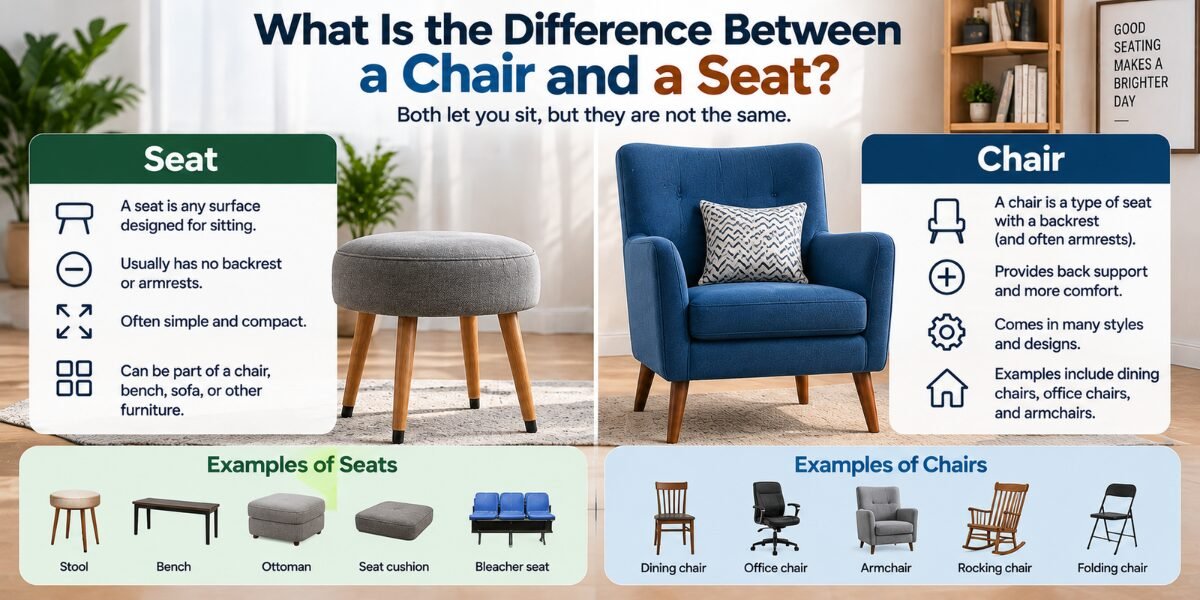
If you have ever used the words “chair” and “seat” as if they mean the same thing, you are not alone. They are closely related, but they do not mean exactly the same thing.
The simple answer is this: a seat is a place made for sitting, while a chair is a type of furniture made for sitting. A chair usually has a seat, but a seat does not have to be a chair.
That small difference becomes clear when we look at how each word is used in daily life.
What Is the Difference Between a Chair and a Seat?
The main difference is that “seat” describes the place or surface where a person sits, while “chair” describes a piece of furniture designed to support a person while sitting.
A chair may have a seat, backrest, legs, and other parts. A seat can be much simpler. It may be part of a chair, a car, a bus, a bench, or even a built-in surface.
For example, if I say, “Please take a seat,” I am talking about a place to sit. I am not telling you to find a specific type of furniture.
If I say, “Please bring me a chair,” I am asking for a complete piece of furniture.
So, the easiest way to remember it is:
| Term | Basic meaning | Example |
|---|---|---|
| Chair | A piece of furniture for sitting | Dining chair |
| Seat | A place or surface for sitting | Car seat |
| Chair seat | The part of a chair where you sit | Padded chair seat |
The two words can overlap, but they are not always interchangeable.
What Is a Chair?
A chair is a piece of furniture made to support one person in a sitting position. Most chairs have a raised seat and often include a backrest.
Some chairs also have armrests. Others have wheels, cushions, adjustable parts, or special support features.
A dining chair is a good example. It is a complete object that can be moved around a room. It gives you a place to sit while also supporting your body.
The word “chair” usually points to the whole item.
This matters because a chair can contain several parts. The seat is only one of those parts.
For instance, if a chair breaks and the seat is still usable, you might still describe the object as a chair. The word refers to the furniture as a whole, not only the surface where you sit.
What Is a Seat?
A seat is the part, place, or surface where someone sits.
It can be part of many different things. A seat can be found in a chair, car, bus, airplane, theater, stadium, or boat.
This makes the word much broader than “chair.”
Think about a car. You would normally call the place where you sit a car seat. You would not call the entire car seat a chair.
The same idea works on a bus. Each passenger has a seat, but the bus does not contain a row of separate chairs in the normal sense.
“Seat” can also describe a position. For example, someone may have a seat at a table or a seat in a theater.
So, the word can describe both a physical sitting area and a place assigned to a person.
Is a Seat Part of a Chair?
Yes. In most common chairs, the seat is one of the main parts.
A basic chair may have four legs, a seat, and a backrest. The seat is the horizontal area that supports the person sitting on it.
Some chairs have a padded seat. Others have wood, plastic, metal, mesh, or other materials.
This shows the relationship between the two terms.
A chair is the complete piece of furniture. The seat is the part that provides the sitting surface.
It is similar to how a car has a door. The door is part of the car, but the door is not the whole car. In the same way, a seat can be part of a chair without being a chair itself.
Can a Seat Be a Chair?
Not always.
A seat can sometimes refer to a complete object that works much like a chair. In casual speech, people may use the words in similar ways.
But the word “seat” has a wider meaning.
A bench provides seats. A sofa provides seats. A car has seats. A stadium has seats. None of these things is simply a chair.
Even a step can serve as a seat if someone sits on it.
This is why “seat” is better understood as a function or place, while “chair” is usually understood as a specific type of furniture.
Chair vs. Seat in Everyday Language
In daily conversation, the difference is often easy to miss.
If someone says, “There is a chair by the window,” they are identifying a piece of furniture.
If they say, “There is a seat by the window,” they are mainly pointing out a place where someone can sit.
The second sentence does not tell you what provides the seat.
It could be a chair, bench, sofa, stool, or another surface.
The context usually tells us what the speaker means.
This is also why phrases such as “take a seat” are common. The phrase focuses on the action of sitting, not the furniture itself.
Chair and Seat in Cars
Cars make the difference very clear.
A car seat is the place where a driver or passenger sits. It may include a cushion, back support, headrest, seat belt, and adjustment controls.
You would not normally call a car seat a chair.
The word “seat” works better because it describes the sitting position within the vehicle.
A car can have several seats. Each seat is part of the vehicle’s interior.
This example shows why “seat” has a broader use than “chair.”
Chair and Seat in Public Places
Public places also show the difference.
A theater may have hundreds of seats. Those seats may be fixed to the floor and arranged in rows.
A stadium also has seats. Some may be individual units, while others may form part of a larger structure.
A bus has passenger seats. An airplane has passenger seats.
In these cases, “seat” describes the place available to each person.
The physical design can be very different from a normal household chair.
Chair vs. Seat: Which Word Should You Use?
Use “chair” when you mean a complete piece of furniture designed for sitting.
Use “seat” when you mean the place or surface where someone sits.
Here are some simple examples:
- “I moved the chair closer to the table.”
- “The chair has a soft seat.”
- “Please take a seat.”
- “My car has five seats.”
- “We found a seat on the bus.”
- “The theater seat was already taken.”
These examples show how the words serve different roles.
When you are talking about furniture, “chair” is often the clearer word. When you are talking about a sitting place, “seat” is usually more suitable.Read moreWhy Are Accent Chairs So Expensive? What You Really Pay For
Why the Difference Matters
Knowing the difference helps you use the right word for the situation.
It can also help when shopping for furniture.
For example, a product may be described as having a comfortable seat. That does not mean the product itself is only a seat. It may be a chair, stool, bench, or office chair.
The word “seat” can describe one feature of the item.
The word “chair” tells you what the item is.
This distinction is useful in product descriptions, furniture guides, home projects, and everyday conversation.
Are Chair and Seat Synonyms?
Chair and seat can be related in meaning, but they are not perfect synonyms.
A chair is one kind of seat. However, many seats are not chairs.
A bench can provide several seats. A sofa can provide multiple seats. A vehicle has seats. A theater has seats.
So, replacing “seat” with “chair” can sometimes change the meaning.
For example, “I found a seat on the train” sounds natural because the train has designated places for passengers to sit.
“I found a chair on the train” would suggest that there was an actual movable chair there.
The context changes the meaning.
Chair, Seat, Stool, and Bench
These terms can be confusing because they all relate to sitting.
A chair is usually designed for one person and often has a backrest.
A stool is usually a simple raised seat and may have no backrest.
A bench is a longer seat that can often hold more than one person.
A seat is the broadest term of the four. It can describe the sitting area on any of these objects.
So, one simple way to view them is:
Seat = the place where you sit.
Chair = a type of furniture that provides a seat.
Stool = a simple type of sitting furniture.
Bench = a longer sitting structure.
The exact design can vary, but the basic difference stays useful.
Common Mistake: Using the Words as Exact Matches
One common mistake is assuming that every seat is a chair.
That is not true.
A seat can be built into another object. It can be fixed in place. It can be part of a larger piece of furniture. It can also refer to a specific position for a person.
A chair, on the other hand, normally refers to a complete furniture item.
This is why the wider word is “seat.”
When I think about the difference, I find it easiest to start with the sitting function. Then I ask what provides that sitting place.
If it is a chair, the answer is “chair.” If it is only the sitting area, “seat” is the better term.
FAQs
What is the main difference between a chair and a seat?
A chair is a type of furniture made for sitting. A seat is the place or surface where a person sits. A chair normally includes a seat as one of its parts.
Is every chair a seat?
A chair provides a seat, so it can serve as a seat. However, “seat” has a wider meaning and can also refer to the sitting place in a car, bus, theater, sofa, or bench.
Is a seat always part of a chair?
No. A seat can be part of many objects or structures. Cars, buses, airplanes, benches, sofas, and stadiums can all have seats.
Can I use “chair” and “seat” interchangeably?
Sometimes, but not in every situation. “Chair” usually means a complete piece of furniture, while “seat” focuses on the place or surface used for sitting.
Why do people say “take a seat” instead of “take a chair”?
“Take a seat” simply means to sit down. The phrase does not require a specific type of furniture. You could sit on a chair, bench, sofa, or another suitable surface.
Conclusion
The difference between a chair and a seat is simple once you look at what each word describes.
A chair is a complete piece of furniture made for sitting. A seat is the place or surface where someone sits. A chair can have a seat, but a seat does not have to be a chair.
When you remember that “seat” is the broader term, the difference becomes much easier to understand. This small detail can also make your everyday speech and writing more precise.