
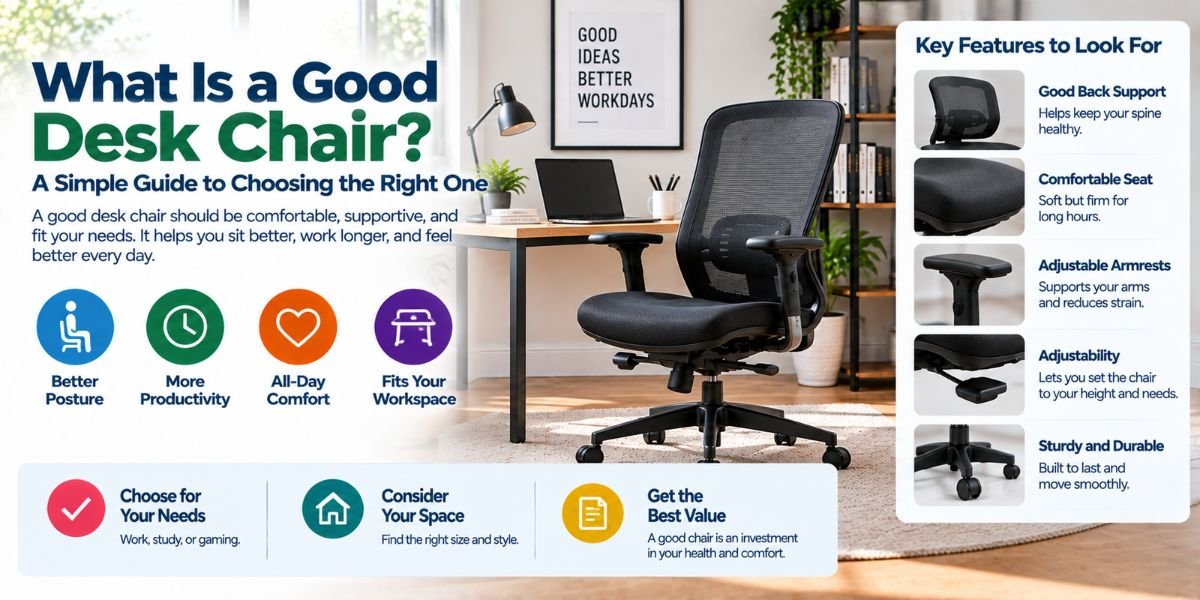
If you spend hours at a desk, a good chair can make a big difference. The right desk chair should feel comfortable, support your body, and let you work without constant shifting or strain.
But what is a good desk chair? It is not just a chair with a soft seat or a high price. A good desk chair fits your body, supports your lower back, keeps your feet stable, and gives you enough adjustment to find a natural sitting position.
I think the best way to judge a desk chair is to look at how it works in real daily use. Comfort matters, but so do seat height, back support, armrests, movement, and long-term use.
What Is a Good Desk Chair?
A good desk chair is one that supports a comfortable and healthy sitting position while giving you enough adjustment to fit your body.
The chair should let you sit with your feet supported, your knees in a natural position, and your back supported. You should also be able to move without feeling trapped in one fixed position.
A good chair does not need to be expensive. Some affordable chairs work very well. The key is finding the right mix of support, comfort, size, and adjustability.
Why Does a Good Desk Chair Matter?
A desk chair can affect how you feel during a long workday. A poor chair may leave you shifting around, leaning forward, or trying to find a comfortable position every few minutes.
This becomes more noticeable when you work at a desk for several hours. Small problems with seat height or back support can become very annoying over time.
For me, comfort is only one part of the picture. A chair should also make it easy to keep a good sitting position without having to think about it all day.
What Should a Good Desk Chair Have?
The best desk chairs tend to share a few useful features. You do not need every feature, but some are much more important than others.
Adjustable Seat Height
Seat height is one of the first things I would check. Your feet should rest firmly on the floor while your knees stay in a comfortable position.
A chair that is too high can leave your feet hanging. A chair that is too low can make your desk feel too high.
An adjustable seat makes it easier to match the chair to your body and desk.
Good Lower Back Support
Lower back support is another key feature. The backrest should support your lower back without forcing you into an awkward position.
Some chairs have fixed lumbar support. Others let you adjust its height or depth.
Adjustability can be useful because people have different body shapes. What feels right for one person may feel wrong for another.
Comfortable Seat
A good seat should give you enough support without feeling hard or restrictive.
Seat depth also matters. If the seat is too deep, you may not be able to sit back comfortably while keeping your back supported. If it is too short, your legs may not feel well supported.
A comfortable seat should work with your body rather than make you adapt to it.
Adjustable Armrests
Armrests can reduce the need to hold your arms up while working. They can also help you keep your shoulders more relaxed.
Adjustable armrests are useful because desk setups and body sizes vary.
Still, armrests are not the most important feature for everyone. If they stop you from getting close enough to your desk, they may become more of a problem than a benefit.
A Supportive Backrest
A backrest should support your back while allowing some natural movement.
I prefer the idea of a chair that supports movement instead of locking the body into one rigid position. Being able to change your sitting position during a long day can make the chair feel more practical.
A breathable back can also be helpful if you tend to get warm while sitting.
How Do You Know if a Desk Chair Fits You?
Chair fit is personal. A chair that feels great to one person may feel uncomfortable to someone else.
Start with the seat height. Your feet should reach the floor comfortably. Then check the seat depth and backrest.
Next, look at the armrests. Your arms should feel supported without forcing your shoulders upward.
Finally, sit back and see how the lumbar area feels. The support should feel useful, not like a hard object pushing into your back.
What Is the Best Sitting Position in a Desk Chair?
A good sitting position starts with your feet supported on the floor or on a suitable footrest.
Your knees should be around a comfortable angle, and your hips should feel stable on the seat. Your back should rest against the backrest instead of leaving you leaning far forward.
Your shoulders should stay relaxed. Your elbows should be close to your body when using your keyboard and mouse.
Your monitor should also be placed at a comfortable height. Even a great chair cannot fix a poor desk setup.
Desk Chair Features That Are Worth Paying For
Not every chair feature is equally useful.
I would put adjustable seat height near the top of the list. Lumbar support is also important, especially if you sit for long periods.
Adjustable armrests can be helpful, but they depend on your desk setup. A reclining backrest can also add comfort if you like to change positions while working.
A headrest is more personal. Some people like it, while others rarely use it.
The main lesson is simple: pay for features that improve fit and support, not features that only make the chair look more impressive.
What Can Make a Desk Chair Uncomfortable?
A chair can look great and still feel bad after a few hours.
One common problem is poor seat depth. Another is a backrest that does not match your body.
Armrests can also cause trouble when they are too high or too wide. Hard edges may become uncomfortable during long sessions.
A chair can also feel wrong if it is too soft. Extra padding may seem comfortable at first, but support and pressure distribution matter more than softness alone.
How Much Should You Spend on a Good Desk Chair?
There is no single price that makes a chair good.
A more expensive chair may offer better materials, more adjustments, or stronger construction. But price alone does not guarantee a good fit.
Before buying, I would focus on the features that matter most for your use. If you work at a desk every day, investing more in a chair may make sense.
If you only use your desk for short periods, you may not need a premium office chair.
The best value comes from getting the support and adjustments you actually need.Read moreWhat Is a Good Computer Chair?
Good Desk Chair vs. Cheap Desk Chair
A cheap desk chair is not automatically bad. The problem starts when low cost comes with poor fit, weak support, or limited adjustment.
A good budget chair can still offer adjustable height, a decent seat, and useful back support.
The real difference is how well the chair meets your needs. I would rather choose a simple chair with useful adjustments than pay extra for features I will never use.
What I Look For in a Good Desk Chair
When I compare desk chairs, I start with basic comfort and fit. I want the seat to feel stable, the backrest to offer useful support, and the controls to be easy to understand.
Then I look at adjustment options. More adjustments are not always better. They should have a clear purpose.
I also think about daily use. A chair that feels good for 20 minutes may not be the best choice for a full workday.
Build quality matters too. If a chair will be used every day, the frame, base, wheels, and adjustment parts all deserve attention.
Quick Desk Chair Checklist
| Feature | What to Look For |
|---|---|
| Seat height | Easy adjustment and comfortable foot support |
| Seat depth | Enough support without pressing behind the knees |
| Lumbar support | Comfortable support for the lower back |
| Backrest | Supportive with room for natural movement |
| Armrests | Comfortable height and useful adjustment |
| Seat padding | Supportive without being overly soft |
| Breathability | Helpful for warm rooms and long sessions |
| Recline | Smooth movement and comfortable positions |
| Base and wheels | Stable and easy to move |
| Adjustments | Simple controls that match your needs |
Who Needs a Good Desk Chair?
A good desk chair is useful for almost anyone who spends a lot of time sitting at a desk.
It can be especially helpful for remote workers, students, gamers, writers, office workers, and people who use a computer for several hours each day.
If you only sit at a desk for a few minutes at a time, you may not need many advanced features.
Your daily use should guide your choice.
When Should You Replace Your Desk Chair?
There is no fixed replacement date for every chair.
Look at its condition and how it feels during use. If the seat has lost its support, the backrest no longer works well, or the adjustment parts have become unreliable, it may be time for a replacement.
Visible damage is another clear warning sign.
A chair that constantly makes you uncomfortable is also worth reconsidering. Even if it still looks fine, poor fit can make it a poor choice for your needs.
FAQs About What Is a Good Desk Chair?
What makes a desk chair good?
A good desk chair offers proper support, comfortable seating, and useful adjustments. It should fit your body and work well with your desk setup.
Is a soft chair better for long hours?
Not always. A very soft seat may feel nice at first but may not provide the support you need. A supportive seat with good pressure distribution is often a better choice.
Should a desk chair have lumbar support?
Yes, useful lower back support can make a chair more comfortable. Adjustable lumbar support can be even better because people have different body shapes.
Are expensive desk chairs worth it?
They can be, but price does not guarantee comfort. Look at fit, support, materials, and adjustments before deciding how much to spend.
How high should a desk chair be?
Set the chair so your feet can rest firmly on the floor while your legs and knees stay comfortable. Your chair should also let you work at your desk without raising your shoulders.
Conclusion
So, what is a good desk chair? It is a chair that fits your body, supports your back, feels comfortable, and gives you enough adjustment for your daily work.
I would not choose a chair based on looks or price alone. Start with seat height, seat depth, back support, armrests, and overall fit.
The right chair should make your desk feel easier to use. When the chair fits you well, you can focus more on your work and spend less time trying to get comfortable.