
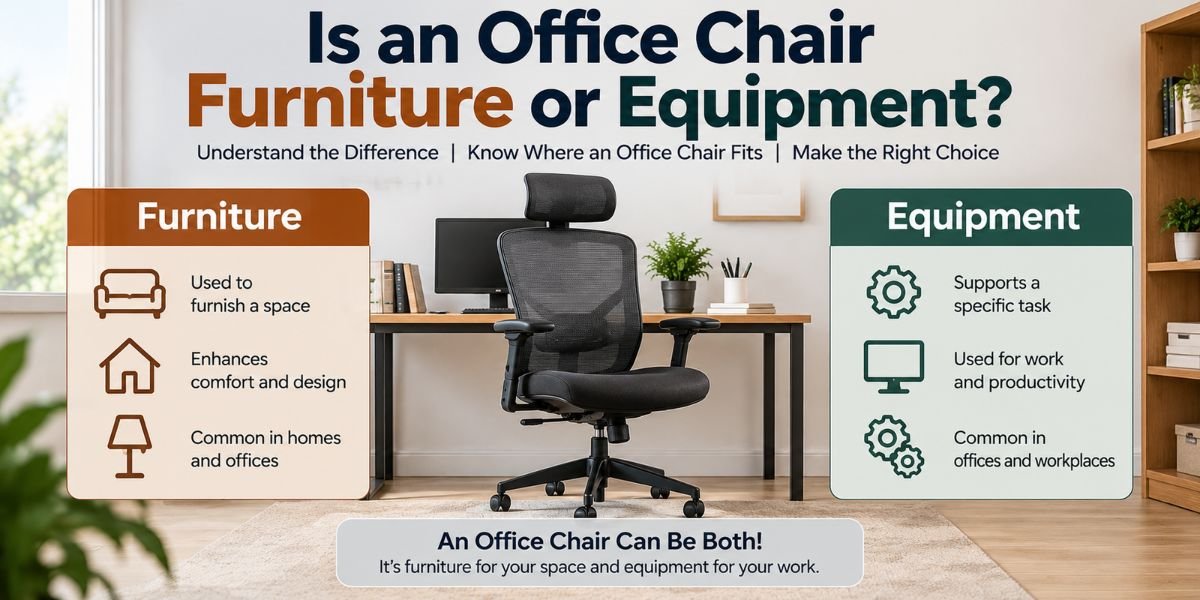
If you are setting up an office, buying a chair, or recording business expenses, you may wonder: is office chair furniture or equipment?
An office chair is generally classified as furniture. It is a movable item made for sitting and supporting work. It is not usually treated like office equipment such as a computer, printer, scanner, or copier.
The exact accounting treatment can still depend on how your business records assets, the cost of the chair, and the tax rules that apply to your situation.
Is an Office Chair Furniture or Equipment?
An office chair is generally considered office furniture.
The main reason is simple. A chair is a physical item that helps furnish a workspace. It does not perform a technical or mechanical office task like a computer or printer does.
Desks, tables, filing cabinets, shelves, and office chairs are common examples of office furniture.
In U.S. tax guidance, office furniture can include chairs and desks. The IRS also treats office furniture and fixtures as a separate property group from many types of office machinery and technology.
So, if you need one simple answer, it is this:
An office chair is usually furniture, not office equipment.
Why Is an Office Chair Considered Furniture?
The easiest way to understand the difference is to look at what the item does.
An office chair provides a place to sit while working. It supports the person using the workspace. It does not normally process information, print documents, store data, or perform another technical office function.
That makes it much closer to a desk than to a computer.
A simple office setup may include:
| Item | Common Classification |
|---|---|
| Office chair | Furniture |
| Office desk | Furniture |
| Filing cabinet | Furniture |
| Conference table | Furniture |
| Computer | Equipment |
| Printer | Equipment |
| Scanner | Equipment |
| Copier | Equipment |
This is a useful general guide, but businesses may use different account names in their own accounting systems.
Can an Office Chair Be a Business Asset?
Yes. An office chair can be a business asset.
The word “furniture” does not mean that the item cannot be an asset. Furniture can be a tangible business asset when a company buys it for long-term business use.
For example, a company may buy 20 office chairs for its employees. The chairs are physical property used in the business. The company may track them as office furniture.
However, the accounting treatment can depend on the company’s capitalization policy.
A low-cost chair may be recorded as an expense instead of being added to a long-term asset account. A more expensive chair may be capitalized if it meets the company’s rules.
Is an Office Chair a Fixed Asset?
It can be.
A fixed asset is generally something a business buys for ongoing use rather than for resale or quick consumption.
Office furniture can fall into this category.
For example, imagine a company buys a high-quality office chair for a long-term employee workspace. The company expects to use it for several years. Under the company’s accounting policy, it may record the chair as a fixed asset.
But this is not automatic for every chair.
The business may have a capitalization threshold. If the chair costs less than that threshold, the company may expense it instead.
So the better answer is:
An office chair can be a fixed asset, but its accounting treatment depends on the company’s rules and applicable accounting or tax requirements.
Is an Office Chair Office Equipment for Accounting?
Usually, it is better described as office furniture.
Some businesses may use a broad account called “Office Equipment” for many office purchases. That does not necessarily mean the chair is technically equipment in every accounting system.
This is where account names can cause confusion.
A company’s chart of accounts may have categories such as:
- Office furniture
- Furniture and fixtures
- Office equipment
- Computer equipment
- General office expenses
An office chair may fit under “furniture and fixtures” even if the business uses a broader asset group for reporting.
The important thing is to follow the accounting policy used by the business and keep the classification consistent.
How Does the IRS Treat Office Chairs?
For U.S. tax purposes, office furniture is treated differently from many types of office machinery.
IRS guidance gives examples of office furniture and fixtures such as desks and chairs. It also identifies office furniture as a type of property used in business.
For many businesses, office furniture falls into the seven-year property category under the general MACRS depreciation system when it is depreciated rather than fully expensed through an available tax provision.
That does not mean every office chair must always be depreciated for seven years.
Tax treatment can change based on factors such as the cost, business use, elections made by the taxpayer, and the specific tax rules that apply.
So I would not use a simple “all office chairs are seven-year assets” rule without checking the current tax situation.
Can You Expense an Office Chair?
Sometimes, yes.
A business may be able to deduct the cost of an office chair rather than depreciating it over several years. The available treatment depends on the applicable tax rules and the business’s circumstances.
Cost is also important.
For example, a basic office chair may be inexpensive enough to fall under a company’s normal expense policy. A very expensive executive chair may be treated differently under that company’s capitalization policy.
Tax rules may also provide options for qualifying property.
This is why the purchase price alone does not tell the whole story. You also need to consider how the business uses the chair and which accounting or tax rules apply.Read moreIs an Office Chair Considered Furniture? What You Need to Know
What About an Ergonomic Office Chair?
An ergonomic office chair is still generally furniture.
The fact that it has adjustable arms, lumbar support, a reclining mechanism, wheels, or other features does not normally turn it into office equipment.
Its purpose is still to provide seating and support in a workspace.
For example, a high-end ergonomic chair may have:
- Adjustable seat height
- Lumbar support
- Adjustable armrests
- Reclining controls
- Head support
- Casters
- Breathable materials
These features can make the chair more useful, but they do not normally change its basic classification as office furniture.
What About a Computer Chair?
A computer chair is also generally office furniture.
The name “computer chair” can make it sound like computer equipment, but the chair itself does not become a computer device.
It is simply designed for people who spend time working at a computer.
The computer and chair serve different roles.
The computer performs technical tasks. The chair supports the person using the computer.
That distinction makes the classification much easier to understand.
What About a Gaming Chair Used at Work?
A gaming chair used for business work can still be treated as furniture.
The label on the product is less important than its physical nature and business use.
If a person uses a gaming-style chair at a business workstation, the item is still a chair. It does not become computer equipment just because it is marketed toward gamers.
The same idea can apply to racing-style chairs, executive chairs, mesh chairs, and other specialized seating.
Does the Price Change the Classification?
The price can change the accounting treatment, but it does not usually change the basic nature of the item.
A $100 office chair and a $1,500 executive chair are both chairs. Both are generally furniture.
What can change is how a business records the purchase.
A company may have an internal rule that says small purchases are expensed immediately. Larger purchases may be recorded as assets and depreciated according to the company’s accounting policy and applicable tax rules.
So it helps to separate two questions:
What is the item?
Usually, office furniture.
How should the business record it?
That depends on the applicable accounting policy and tax rules.
Office Chair vs. Office Equipment
The difference becomes clearer when you compare their main purpose.
Office furniture mainly supports the physical workspace. Office equipment usually performs a work-related technical or operational function.
For example, a chair supports the worker. A desk supports the workspace. A printer produces documents. A computer processes information.
This is not a perfect rule for every accounting system, but it is a useful way to understand the difference.
If you are unsure about a particular item, look at its primary function rather than its marketing name.
What Account Should an Office Chair Go Under?
For many businesses, an office chair may be recorded under an account such as “Office Furniture” or “Furniture and Fixtures.”
The exact account name depends on the company’s chart of accounts.
Some businesses may use a broader fixed-asset account. Others may have separate accounts for desks, chairs, office equipment, and computer equipment.
There is no universal account name that every business must use for every chair.
The important part is to use a classification that fits the company’s accounting policy and apply it consistently.
Common Mistakes When Classifying Office Chairs
One common mistake is assuming that anything used near a computer is computer equipment.
That is not how the classification normally works.
Another mistake is assuming that every office chair must be capitalized. A chair can be furniture while still being treated as an ordinary expense under an applicable policy.
I also would not assume that a company’s internal accounting category is the same as its tax classification. Financial reporting and tax reporting can have different rules.
If the amount is significant, the safest approach is to check the company’s accounting policy and the current tax rules.
Quick Answer: Furniture or Equipment?
If you only need the short answer, an office chair is generally furniture.
It may also be recorded as a business asset if it meets the company’s asset rules. In some cases, its cost may instead be expensed.
The words “furniture,” “fixed asset,” and “expense” describe different things. That is the key point.
Furniture describes what the item is. Fixed asset describes how it may be recorded. Expense describes how a cost may be recognized.
Understanding that difference removes much of the confusion.
FAQs
Is an office chair considered furniture?
Yes. An office chair is generally considered office furniture because it is a movable item used to furnish and support a workspace.
Is an office chair considered office equipment?
Usually, an office chair is classified as furniture rather than technical office equipment. A business may still use a broader account called office equipment, depending on its own chart of accounts.
Is an office chair a fixed asset?
It can be. If the chair meets the company’s capitalization rules and is expected to provide long-term business use, it may be recorded as a fixed asset.
Can an office chair be deducted as a business expense?
It may be possible, depending on the cost, business use, accounting policy, and applicable tax rules. Some qualifying purchases may be expensed instead of depreciated.
Is an ergonomic chair still office furniture?
Yes. An ergonomic chair is still generally furniture. Extra features such as lumbar support, adjustable arms, and reclining controls do not normally change its basic classification.
Conclusion
So, is office chair a furniture or equipment?
An office chair is generally office furniture. It can also be a business or fixed asset when it meets the company’s accounting rules. In other cases, the cost may be recorded as an expense.
The most important thing is to separate the item’s type from its accounting treatment. A chair is usually furniture, while the way its cost is recorded depends on the business’s policy and the rules that apply.