
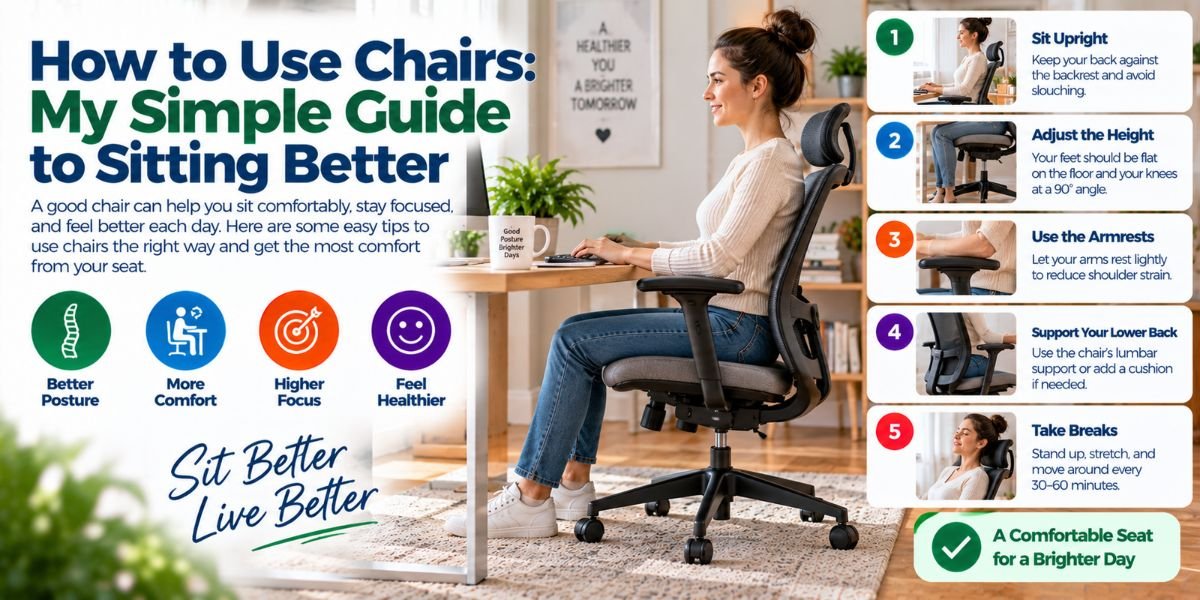
A chair seems simple. You sit on it and get up when you are done. But how you use a chair can affect comfort, posture, balance, and even how much space you have in a room.
The right way to use a chair depends on the type. A dining chair is made for meals. An office chair is made for work. A lounge chair is made for rest. Each one supports your body in a different way.
In this guide, I’ll explain how to use chairs in a simple and practical way. I’ll cover sitting position, chair height, back support, armrests, foot placement, and common mistakes.
How to Use Chairs the Right Way
The basic rule is simple: sit in a way that lets your body stay relaxed and supported.
Start by sitting all the way back in the chair. Let your back rest against the backrest instead of sitting only on the front edge.
Keep both feet supported. If your feet do not reach the floor, the chair may be too high for you.
Your knees should stay in a natural position. You should not need to stretch your legs far forward just to feel comfortable.
Try not to lean to one side for long periods. A balanced sitting position is easier on your body.
The goal is not to sit perfectly still. It is better to change position from time to time than to hold one stiff pose for hours.
How to Sit in a Chair
When I think about how to use chairs well, I start with the seat itself.
Sit near the back of the seat. Let the chair support you instead of holding your body up with your muscles.
Keep your shoulders loose. Do not lift them toward your ears.
Place your feet on the floor when possible. Keep your weight spread in a comfortable way across the seat and your feet.
If the chair has a backrest, use it. A backrest is there to support your back and help you stay comfortable.
Avoid sitting on one leg or twisting your body for long periods. These habits can make a chair feel uncomfortable even when the chair itself is well designed.
How to Use an Office Chair
An office chair needs a little more attention because you may use it for many hours.
First, adjust the seat height. Your feet should rest on the floor or on a footrest. Your knees should stay in a comfortable position.
Move close enough to your desk so you do not need to reach far forward.
Your back should stay supported by the chair. If the chair has adjustable lumbar support, place it where it feels useful and comfortable.
Keep your shoulders relaxed while using your keyboard and mouse.
Your elbows should stay close to your body. You should not need to reach far out to use your desk.
An office chair should also let you move. You do not need to lock your body into one position all day.
Stand up and change position at regular times. Even a good chair cannot replace movement.
How to Use a Dining Chair
Dining chairs are usually used for shorter periods, but good sitting habits still matter.
Pull the chair close to the table before eating. This helps you avoid leaning forward too much.
Keep your feet on the floor. Try to keep your body facing the table instead of turning to one side.
The chair should let you sit at a comfortable height for the table. If the seat is too low, you may need to lift your shoulders or bend forward.
If the chair has no armrests, keep your arms relaxed when they are not being used.
Do not push the chair so close to the table that your knees hit the underside.
Good spacing matters too. Everyone at the table needs enough room to move their arms and get in and out easily.
How to Use a Lounge Chair
A lounge chair is made for a more relaxed sitting position.
You can sit deeper into the chair and let the back support more of your body. Many lounge chairs have a deeper seat than dining or desk chairs.
Before settling in, check your feet. They should still have a comfortable position.
If the seat is very deep, a cushion behind your back may help. This can bring you forward and give you more support.
Use the armrests when they feel comfortable. They can give your arms a place to rest while reading, watching TV, or relaxing.
A lounge chair should feel easy to use. If you have to keep shifting because the seat is too deep, too low, or too hard, the size may not suit you.
How to Use Armrests
Armrests can make a chair more comfortable, but only when they are the right height.
Let your arms rest naturally. Do not push your shoulders upward to reach the armrests.
You also do not need to put your arms on them all the time.
When working at a desk, make sure the armrests do not stop you from getting close to the desk. This is a common problem with large office chairs.
If the armrests hit the desk, you may sit too far away. That can make you lean forward while working.
Adjustable armrests can help solve this problem.
How to Use a Chair Without Hurting Your Back
A chair does not automatically cause or prevent back discomfort. Your sitting habits, chair design, activity, and other factors all matter.
Start with the chair’s support.
Sit back and use the backrest. Avoid staying on the front edge of the seat for long periods.
Keep your work or reading material close enough that you do not need to bend forward again and again.
Change your position during long sitting sessions.
If a chair feels uncomfortable, do not assume you simply need to “sit correctly.” The chair may be too high, too low, too deep, or poorly matched to your body.
Small adjustments can make a big difference.
How to Use a Chair at the Correct Height
Chair height affects how your legs, feet, and arms sit.
If the chair is too high, your feet may hang or press only with your toes. You may also feel pressure under your thighs.
If the chair is too low, your knees may sit higher than you want. You may also need to bend your legs more than feels natural.
For an office chair, start by placing your feet flat on the floor. Then check your desk and arm position.
For a dining chair, compare the seat height with the table. You want enough space for your legs and enough height to eat comfortably.
There is no single chair height that works for every person.
How to Use a Chair With a Footrest
A footrest can help when your chair is too high for your feet to rest comfortably.
Place your feet on the footrest instead of letting them hang.
The footrest should be stable. It should not slide away every time you move your feet.
A footrest can also be useful at a desk when raising the chair is needed for a better working position.
The key is to support your feet without forcing your knees into an awkward position.
Common Chair Mistakes
One common mistake is sitting on the edge of the seat for too long.
Another is leaning forward toward a screen, book, or meal. This often happens when the chair or desk is not set up well.
Some people also sit with one leg tucked under them. It may feel comfortable for a while, but changing positions is still important.
Using a chair that is too large is another problem. A deep seat may look comfortable but can make it hard for shorter users to sit with proper foot support.
A chair that is too small can create the opposite problem. Your body may feel cramped, and the backrest may not support you well.
How to Use Chairs for Different Activities
The best sitting method changes with the task.
At a desk, you need support and easy access to your keyboard, mouse, and screen.
At a dining table, you need enough room to move your arms and legs.
While reading, you may want more back support and a relaxed seat angle.
While watching TV, a deeper lounge chair can give you more freedom to change position.
For short waiting periods, comfort may matter less than easy movement.
This is why I would not use the same chair setup for every task. A chair should match what you are asking it to do.Read moreHow to Describe a Comfortable Chair: Simple Words That Help Readers Feel the Comfort
How to Use Chairs in a Small Room
A chair can also affect how a room works.
Place the chair where people can move around it easily. Do not block a main walkway just to create another seat.
For a small room, a chair with a smaller footprint can be easier to manage.
Think about the full chair size, including the arms and back. A wide chair can take more space than its seat suggests.
If the chair reclines, check the space behind and in front of it too.
A simple way to test the setup is to mark the chair’s footprint on the floor with tape. This lets you see how much room it will really use.
How to Care for a Chair During Daily Use
Good use also means treating the chair properly.
Do not stand on a chair unless it is specifically designed for that purpose.
Do not drag a heavy chair across the floor if doing so can damage the legs or flooring.
Avoid placing more weight on the chair than it is designed to support.
Keep moving parts clean when the chair has wheels, hinges, or a reclining system.
Check loose screws and fittings from time to time. Small problems are easier to deal with before they become larger ones.
For upholstered chairs, follow the care instructions for the fabric or material. Do not use a cleaner just because it works on another type of fabric.
How to Know if You Are Using the Right Chair
A chair may be the wrong fit even when it looks great.
Your feet should have a comfortable place to rest. The seat should give you enough room without forcing you too far forward.
The backrest should support you in a useful position.
Your arms should be able to relax without lifting your shoulders.
You should also be able to get in and out without fighting the chair.
If you keep adjusting yourself every few minutes, pay attention to why. The problem may be the chair’s size or design rather than your sitting habit.
Practical Tips for Better Chair Use
Start with the basics. Sit back, support your feet, and relax your shoulders.
Then look at the chair’s height and depth. These two measurements can change how the chair feels more than many extra features.
Use armrests when they help. Move when you need to. Do not stay in one position just because you think it is the “perfect” posture.
For long periods of sitting, take regular breaks. Stand up, walk around, and change your position.
Most of all, pay attention to comfort. A chair should support your task without making you constantly think about the chair itself.
FAQs About How to Use Chairs
How should you sit in a chair?
Sit back in the seat and use the backrest for support. Keep your feet supported and your shoulders relaxed.
How should I use an office chair?
Adjust the chair so your feet are supported and your desk feels easy to reach. Use the backrest and change position during long work sessions.
Should my feet touch the floor when sitting?
Ideally, yes. If your feet cannot reach the floor because the chair is high, a stable footrest can provide support.
Is it bad to sit on the edge of a chair?
Sitting on the edge for a short time is not the main issue. Staying there for long periods can reduce back support and may make you lean forward.
How do I know if a chair fits me?
Check the seat height, seat depth, back support, and overall width. You should be able to sit comfortably with your feet supported and without feeling cramped.
Conclusion
Learning how to use chairs well is mostly about simple habits.
Sit back when the chair gives you back support. Keep your feet supported. Set the height to match your body and task. Keep your work close enough that you do not need to lean forward.
Different chairs also need different setups. An office chair should support long work sessions, while a lounge chair should give you a more relaxed position.
The best approach is to choose a chair that fits your body and use it in a way that lets you move, relax, and stay supported throughout the day.