
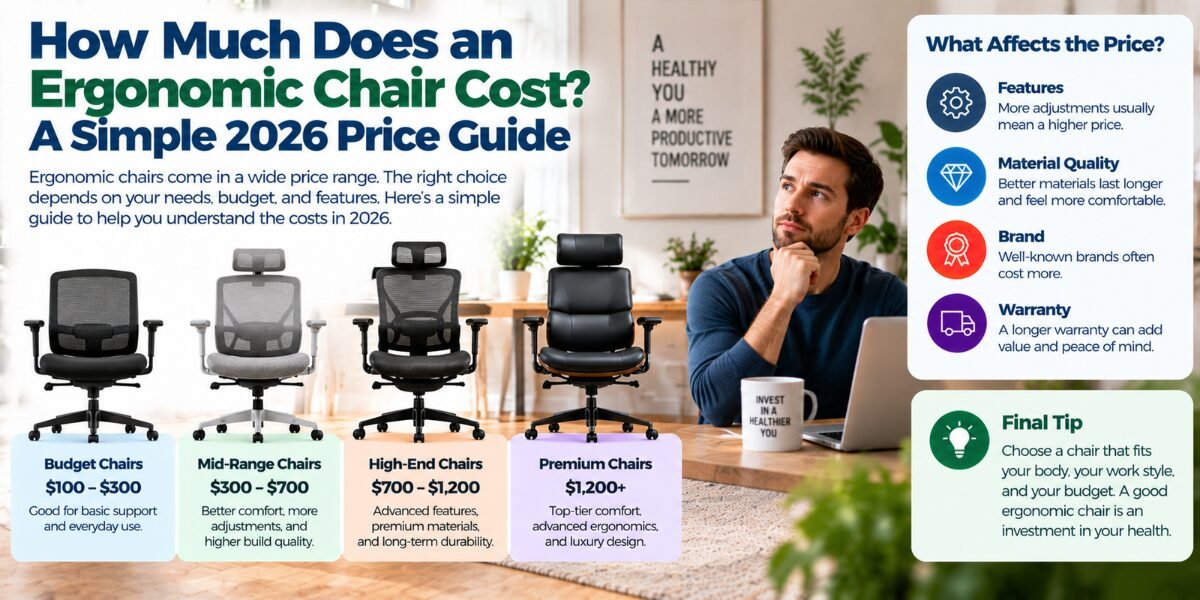
If you are asking how much does an ergonomic chair cost, the short answer is simple: most good options cost about $200 to $1,000, while premium chairs can cost $1,500 to $2,500 or more.
The price can change a lot based on the chair’s build, support, adjustability, materials, and brand. A $250 chair may be enough for a home office. A $1,500 chair may make more sense for someone who sits for many hours each day.
I looked at the main price levels and features that affect the cost. Here is what I found.
How Much Does an Ergonomic Chair Cost?
An ergonomic chair can cost anywhere from about $100 to more than $2,500.
For most people, though, the useful price range is narrower. A chair between $250 and $700 can offer a good mix of comfort, support, and features.
| Ergonomic Chair Price | What You Can Usually Expect |
|---|---|
| $100–$200 | Basic ergonomic features |
| $200–$400 | Good entry-level support |
| $400–$700 | Better build and adjustability |
| $700–$1,200 | Premium materials and stronger features |
| $1,200–$2,500+ | High-end ergonomic design |
These are general price ranges, not fixed rules. Sales, materials, features, and brand can move a chair into a different range.
The most expensive chair is also not always the best chair for you.
What Is a Good Price for an Ergonomic Chair?
For a typical home office, I would look closely at the $250 to $600 range.
This is where many buyers can find useful features without paying for extras they may never use. You can often get adjustable seat height, lumbar support, armrests, tilt control, and a better seat than you would find on a very cheap chair.
If you sit for eight or more hours a day, spending more can make sense. A $700 chair may feel expensive at first, but the cost can be easier to justify when the chair is used every workday.
For occasional use, I would not rush toward a $1,500 chair.
Ergonomic Chair Cost by Price Level
Under $200
This is the budget range.
You can find chairs with basic ergonomic features in this group. Many have adjustable height, a padded seat, a mesh back, and simple lumbar support.
The main issue is that low-cost chairs often cut corners somewhere. The frame, padding, armrests, wheels, or adjustment system may not feel as refined.
I would consider this range for light home use, a spare desk, or a short daily work session.
$200 to $400
This is a more interesting range for many home users.
Chairs in this group can offer a better balance of comfort and function. You may find adjustable armrests, deeper seat adjustments, improved lumbar support, and smoother recline systems.
This is also where I would start looking if I planned to work at a desk every day.
A chair does not need to cost $1,000 to be useful. Good design matters more than the price tag alone.
$400 to $700
This is often the sweet spot for a serious home office.
At this level, chairs may have better frames, stronger adjustment systems, more comfortable materials, and more ways to fit the chair to your body.
You may also get better warranty coverage or a more established design.
If I were buying one chair for daily work and wanted to balance price with long-term use, this is one of the first ranges I would compare.
$700 to $1,200
Now you are entering the premium market.
Chairs in this range often focus on fine adjustment, long-term comfort, high-quality materials, and better construction.
Some also offer more advanced back support systems or breathable suspension materials.
The difference is not always obvious during the first five minutes of sitting. It can become more important after several hours of use.
$1,200 to $2,500+
This is the high-end category.
Some well-known ergonomic chairs now reach or pass $2,000. For example, current Herman Miller pricing puts some Aeron configurations well above $1,500, with certain versions reaching more than $2,500.
At this price, you are paying for more than basic comfort. Build quality, adjustment options, materials, design, warranty coverage, and long-term use all become part of the value.
That does not mean everyone needs a chair this expensive.
What Makes an Ergonomic Chair More Expensive?
Several things can raise the price.
Adjustability
More adjustment usually means a higher price.
A basic chair may only let you change the seat height. A more advanced chair may let you adjust the seat depth, arm height, arm width, recline tension, lumbar support, back position, and more.
These controls can help you create a better fit.
But more controls are not automatically better. I would rather have five useful adjustments than ten confusing ones.
Lumbar Support
Lumbar support can have a big effect on the price.
A basic chair may use fixed padding. A premium chair may use adjustable lumbar support that can move up, down, forward, or backward.
The important thing is fit.
A fancy lumbar system is not useful if it does not match your body or sitting position.
Materials
Materials also affect cost.
Cheap chairs may use basic foam, plastic parts, and simple fabric. More expensive chairs may use stronger frames, higher-quality upholstery, breathable mesh, or engineered suspension materials.
Mesh can also change the feel of a chair. It may be cooler than thick padding, which can matter if you sit for long periods.
Build Quality
A strong frame and solid adjustment parts can add to the price.
This is one reason I would not judge an ergonomic chair only by how soft it feels in a showroom or product photo.
A chair is a mechanical product. Its moving parts matter.
Brand and Warranty
A well-known brand can charge more for its design, support, warranty, and reputation.
Some premium office chairs also come with long warranties. That can make a higher upfront price easier to understand.
Still, I would compare the actual warranty terms instead of assuming an expensive chair has better coverage.
Is an Expensive Ergonomic Chair Worth It?
Sometimes yes, but not for everyone.
If you sit at a desk for one or two hours a day, spending $1,500 may be hard to justify.
If you work from home every day and sit for many hours, the calculation changes.
I think the better question is not, “How expensive is the chair?”
Ask, “How often will I use it, and how well does it fit me?”
A $400 chair that fits your body well can be a better buy than a $1,500 chair that feels wrong.
How Much Should You Spend for a Home Office?
For a basic home office, I would start around $200 to $400.
For daily work, I would consider about $300 to $700.
For heavy daily use, a budget of $700 to $1,200 gives you more premium options.
There is no need to spend thousands unless you have a clear reason.
Your budget should also include possible extras. A headrest, upgraded casters, footrest, floor mat, or other accessories can raise the total cost.
Should You Buy a Cheap or Expensive Ergonomic Chair?
A cheap chair can make sense when your use is limited.
For example, a student who sits at a desk for a few hours may not need a premium office chair. A guest room desk also does not need the same setup as a full-time home office.
An expensive chair makes more sense when you use it every day.
I would also consider how long you expect to keep it. A chair that costs more but lasts much longer may have better value than a cheaper chair that needs replacement sooner.Read moreHow Much Does a Dining Chair Cost? A Simple 2026 Price Guide
What Should I Look for Before Paying More?
I would check these points before looking at the price alone:
- Seat height adjustment
- Seat depth
- Lumbar support
- Armrest adjustment
- Backrest movement
- Recline control
- Seat comfort
- Weight capacity
- Chair size
- Warranty
- Return policy
- Replacement parts
Fit should come first.
A chair can have excellent specifications and still feel uncomfortable for your body.
If possible, try the chair before making a large purchase. Sitting for a few minutes can tell you whether the seat feels right, but a longer trial is even better.
Are $100 Ergonomic Chairs Worth It?
They can be, but I would keep expectations realistic.
A $100 chair may have a few useful ergonomic features. It may work well for short sessions or occasional use.
The concern is long-term comfort and durability.
If you spend most of your workday in the chair, I would rather save for a stronger option than buy the cheapest chair available.
Are $500 Ergonomic Chairs Worth It?
A $500 ergonomic chair can be a very good middle ground.
At this price, you can often find a chair with several useful adjustments and better overall construction.
You are also far below the price of many luxury ergonomic chairs.
For a home office user who works at a desk every day, $500 can be a sensible budget.
Do You Need a $1,000+ Ergonomic Chair?
No.
A $1,000 chair can offer excellent materials and advanced features, but the extra cost does not guarantee a better fit.
Some people will notice a major difference. Others may be just as comfortable in a $400 or $600 chair.
Your body, desk setup, sitting habits, and work hours matter.
I would only move into the $1,000-plus range when the chair offers something I truly need.
My Simple Ergonomic Chair Budget Guide
If you want a quick way to choose a budget, use this guide.
For occasional use, aim for $150 to $250.
For a basic home office, $200 to $400 is a practical starting point.
For daily work, $300 to $700 is a strong range to explore.
For long workdays and premium features, $700 to $1,200 may be worth considering.
For high-end office seating, $1,200 to $2,500 or more is possible.
The right choice depends more on fit and use than on the biggest price tag.
FAQs
How much does an ergonomic chair cost?
Most good ergonomic chairs cost about $200 to $1,000. Premium models can cost $1,500 to $2,500 or more.
What is a good price for an ergonomic office chair?
For many home office users, $250 to $600 is a good range. It can provide useful support and adjustment without the cost of a luxury chair.
Is a $500 ergonomic chair worth it?
Yes, especially if you use your chair every day. A $500 budget can give you access to better adjustment, comfort, and build quality.
Are expensive ergonomic chairs better?
Not always. Expensive chairs may use better materials and offer more adjustments, but the best chair is the one that fits your body and work style.
Can I get a good ergonomic chair for under $200?
Yes, but choices may be more limited. Under $200, focus on basic adjustability, seat comfort, lumbar support, weight capacity, and return terms.
Conclusion
So, how much does an ergonomic chair cost? A useful answer is around $200 to $1,000 for most buyers, with premium models reaching $1,500 to $2,500 or more.
For many home offices, I would start around $250 to $600. That range can offer a strong balance of comfort, support, features, and cost.
The biggest lesson is simple: do not buy an ergonomic chair based on price alone. Look at fit, adjustment, build quality, warranty, and how many hours you will use it. The right chair is not always the most expensive one. It is the one that works well for you.