
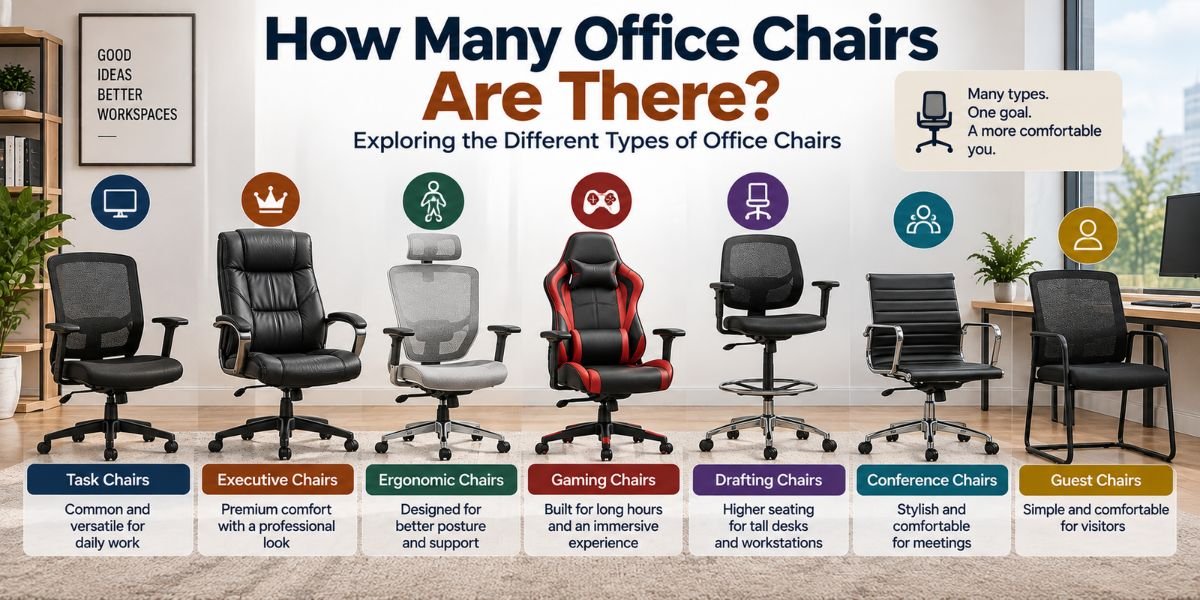
If you search for how many office chairs are there, you may expect one exact number. The truth is a bit different. There is no single official count because office chairs are grouped in many ways.
In simple terms, there are about 10 to 16 common office chair types, depending on how they are classified. Some are made for daily desk work. Others are built for meetings, tall desks, long work hours, or special seating needs.
I find it easier to think about office chairs by their main job. Once you do that, the choices make much more sense.
How Many Office Chairs Are There?
There are many office chair types, but the most common ones include:
| Office chair type | Best use |
|---|---|
| Task chair | Everyday desk work |
| Ergonomic chair | Long work hours |
| Executive chair | Private offices and leadership spaces |
| Mesh chair | Cool and breathable seating |
| Conference chair | Meetings |
| Guest chair | Visitors and waiting areas |
| Drafting chair | High desks and work surfaces |
| Big and tall chair | Larger users |
| Kneeling chair | Alternative sitting posture |
| Saddle chair | Active and upright sitting |
| Stool | Short tasks and shared spaces |
| Gaming chair | Computer and gaming setups |
| Petite chair | Smaller users |
| Active sitting chair | Frequent movement while sitting |
| Reception chair | Lobby and front desk areas |
The exact number can change because some chair types overlap. For example, a chair can be both ergonomic and mesh. A drafting chair can also have ergonomic features.
So, it is better to focus on what each chair does rather than trying to find one final number.
What Are the Main Types of Office Chairs?
1. Task Chairs
Task chairs are among the most common office chairs. They are made for normal desk work such as typing, emails, calls, and computer work.
They are usually smaller than executive chairs. Many have wheels, a swivel base, and basic height adjustment.
I would look at a task chair first if the goal is simple daily office use without a large or bulky design.
2. Ergonomic Office Chairs
Ergonomic chairs focus on support and adjustment. They can have features such as adjustable seat height, armrests, lumbar support, seat depth, and recline control.
These chairs are useful for people who spend many hours at a desk.
What I like about this type is the ability to fit the chair to the person. A chair that fits well can feel much better than one that only looks comfortable.
3. Executive Office Chairs
Executive chairs are usually larger and more padded. They often have a high back and a more formal look.
These chairs are common in private offices and leadership spaces. They can feel substantial, but their large size may not work well in a small room.
If space is limited, I would not choose an executive chair just because it looks impressive.
4. Mesh Office Chairs
Mesh chairs use mesh on the back and sometimes on the seat. The open material allows more airflow than solid upholstery.
This can be useful in a warm office or for people who dislike a hot chair.
One thing I always check is the feel of the mesh. A breathable back is useful, but the chair still needs enough support for the way I sit.
5. Conference Chairs
Conference chairs are made for meeting rooms. They usually focus on a clean look, easy movement, and simple seating.
They do not always offer the level of adjustment found in an ergonomic desk chair.
That is fine because a meeting chair does not need to do the same job as an all-day work chair.
6. Guest and Reception Chairs
Guest chairs are made for visitors. You may see them in reception areas, waiting rooms, private offices, and shared spaces.
Many are stationary instead of rolling. They are often simple to clean and easy to move.
For this type, I would pay more attention to stability, comfort, size, and how easy the chair is to maintain.
7. Drafting Chairs
Drafting chairs are taller than normal office chairs. They are designed for high desks, drafting tables, counters, and similar work surfaces.
Many include a foot ring. This gives the feet a place to rest when the seat is raised.
A normal office chair can feel too low at a tall work surface. That is where a drafting chair makes more sense.
8. Big and Tall Office Chairs
Big and tall chairs are designed with larger users in mind. They may have wider seats, taller backs, and stronger frames.
The important point is not just the chair’s listed weight rating. I would also check the actual seat width, seat depth, back height, and armrest spacing.
A chair can have a high weight rating and still feel like a poor fit.
9. Kneeling Chairs
Kneeling chairs use a different sitting position. Part of the body weight is supported through the knees and lower legs.
They are not a normal replacement for every desk chair. Instead, they offer another way to sit.
I see this type as more of an alternative seating option. It can be useful for people who want to change positions during the day.
10. Saddle Chairs
Saddle chairs have a seat shaped more like a saddle than a traditional office chair.
They encourage a more upright sitting position and allow the legs to move more freely.
They can work well for certain tasks, especially when the user needs to lean forward or move around often.
They are not the right choice for every desk, though. The desk height and work style matter a lot.
11. Office Stools
Office stools are useful when a full backrest is not needed. Some are fixed, while others swivel or adjust in height.
You may find them in creative spaces, shared work areas, labs, counters, and short-task stations.
They are usually better for shorter periods than a fully supportive desk chair.
12. Gaming Chairs
Gaming chairs are often used at computer desks. Many have high backs, padded seats, armrests, and reclining functions.
Despite the name, they are not limited to gaming. Some people use them for work or study.
Still, I would judge one as an office chair based on its fit and support, not its gaming look.
13. Petite Office Chairs
Petite chairs are designed for smaller users. The seat may be shorter, narrower, or lower than a standard chair.
This matters because a chair that is too deep can make it hard for a shorter person to sit with proper support.
Size is often overlooked when people compare office chairs. I think it should be one of the first things to check.
14. Active Sitting Chairs
Active seating includes chairs and stools that allow more movement while sitting.
Some have flexible bases. Others allow gentle movement or changes in position.
The main idea is simple: you are not locked into one stiff sitting position.
These chairs can be useful in areas where people need to move often or switch between short tasks.Read moreWhat Is the Difference Between a Seat and a Chair? A Simple Guide
15. Folding and Stackable Office Seating
Some office seating is designed mainly for easy storage. Folding chairs can be stored between uses, while stackable chairs can be placed on top of each other.
These are useful for training rooms, multipurpose offices, events, and spaces that change layout often.
They are not usually my first choice for eight hours of desk work. Their main strength is flexibility.
Why Are There So Many Office Chair Types?
The main reason is that office work is not one single activity.
A person working at a computer all day has different needs from someone attending meetings. An architect working at a tall table needs a different height from someone sitting at a standard desk.
Body size also changes the choice. So do room size, work habits, desk height, and how long someone sits.
This is why one chair cannot be perfect for every office.
Which Office Chair Type Is Best for Long Work Hours?
For long desk sessions, I would start with an ergonomic office chair or a well-fitted task chair with useful adjustments.
The key is not the label alone. Look for a seat height that fits the desk, comfortable seat depth, useful back support, adjustable armrests when needed, and a recline setting that feels natural.
A very expensive chair can still be a poor match if the size does not fit the user.
Which Office Chair Is Best for a Small Office?
A task chair or compact ergonomic chair is often a better choice for a small office.
These chairs usually take less floor space than large executive models. A chair with a compact base can also make it easier to move around a tight desk area.
Before buying, I would measure the space around the desk. Do not measure only the chair itself. Leave room for the chair to roll back and for the user to stand up.
How Do I Choose Between Office Chair Types?
I would use five simple questions:
- How many hours will I sit each day?
- What type of work will I do?
- How high is my desk or work surface?
- Does the chair fit my body size?
- How much room do I have?
If I work at a normal desk for most of the day, I would look at task and ergonomic chairs first.
If I use a high desk, I would consider a drafting chair. If I need seating for visitors, I would look at guest chairs instead.
This approach is much easier than choosing a chair based only on appearance.
Office Chair Types by Work Situation
| Work situation | Chair types to consider |
|---|---|
| Full-day computer work | Ergonomic or task chair |
| Private office | Executive or ergonomic chair |
| Meeting room | Conference chair |
| Reception area | Guest or reception chair |
| High desk | Drafting chair |
| Smaller user | Petite office chair |
| Larger user | Big and tall chair |
| Alternative seating | Kneeling or saddle chair |
| Shared workspace | Task or active chair |
| Temporary seating | Folding or stackable chair |
What I Would Check Before Buying
I would not start with color or style. I would start with fit.
Check the seat height first. Your feet should have a stable place to rest while you work.
Then look at seat depth. A seat that is too deep can make it hard to sit back against the backrest.
Next, check the armrests and back support. Make sure they do not force your shoulders into an awkward position.
Finally, think about the desk. Even a good chair can feel wrong when the desk height does not match it.
Are All Office Chairs Made for All-Day Sitting?
No.
Some office chairs are made for long desk work. Others are designed for meetings, visitors, short tasks, or special work surfaces.
This is one of the easiest mistakes to make when shopping. A chair can look comfortable in a photo but still be a poor choice for a full workday.
I would always match the chair to the amount of time it will actually be used.
FAQs
How many office chairs are there?
There is no official number. Depending on how they are grouped, there are roughly 10 to 16 common office chair types, with many variations within each type.
What is the most common type of office chair?
Task chairs are among the most common office chairs. They are made for everyday desk work and are usually compact, practical, and adjustable.
What type of office chair is best for long hours?
An ergonomic chair is often a good starting point for long work hours. The best choice still depends on your body size, desk height, sitting habits, and the chair’s adjustment range.
What is the difference between a task chair and an ergonomic chair?
A task chair is built for general desk work. An ergonomic chair usually offers more ways to adjust the chair to the user’s body and sitting position.
Are executive chairs good for everyday work?
They can be, but the large size and deep padding are not ideal for everyone. For long computer work, I would compare the actual support and adjustment options instead of choosing by appearance.
What type of office chair is best for a high desk?
A drafting chair is usually the better match for a high work surface. Many models also have a foot ring to give your feet support at the higher seat position.
Are mesh office chairs better?
Not always. Mesh can improve airflow and reduce the warm feel of a solid back, but comfort and support still depend on the chair’s design and fit.
Conclusion
So, how many office chairs are there? There is no single final number. A practical answer is that there are around 10 to 16 common types, plus many variations based on size, materials, features, and purpose.
The better question is which type fits your work.
For normal desk work, I would start with task or ergonomic chairs. For meetings, guest areas, high desks, or special seating needs, other types make more sense.
Once I match the chair to the job, the desk, and the person using it, choosing becomes much easier.