
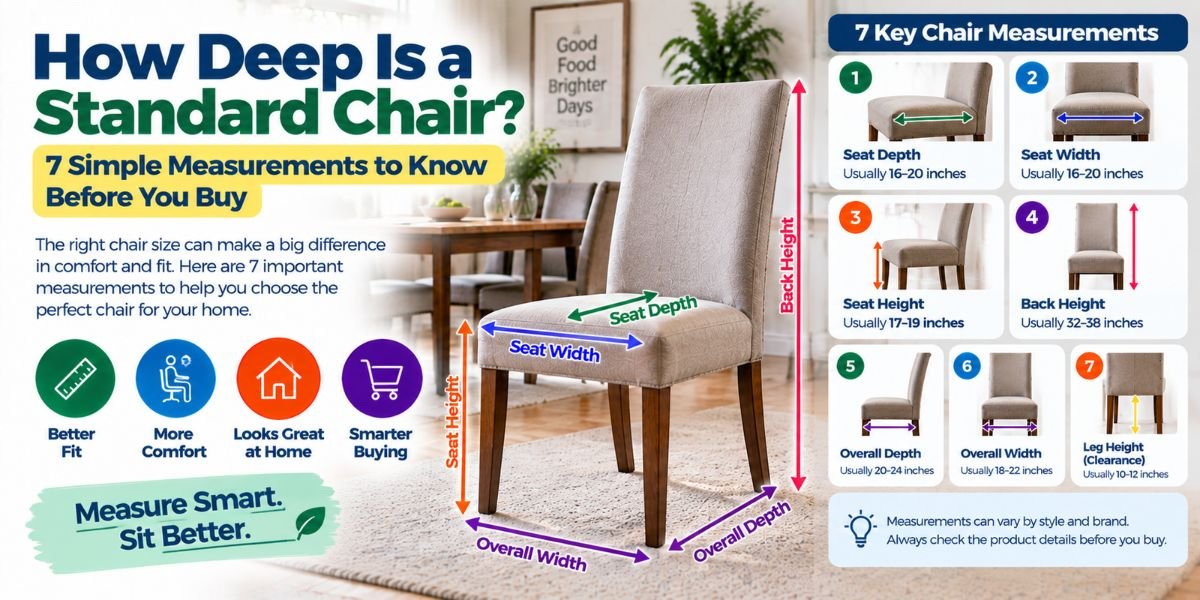
A standard chair is usually around 15 to 18 inches deep at the seat. That is the part that supports your thighs, not the full front-to-back size of the chair.
For many dining and upright chairs, 16 to 18 inches is a common range. But there is no single depth that works for everyone. Your height, sitting style, chair type, and table all matter.
I think this is easy to miss when shopping for chairs. A chair can look perfect in a photo and still feel too deep once you sit down.
So, if you are asking, “how deep is a standard chair?” here is the simple answer: start with about 15 to 18 inches of seat depth. Then check how your legs and back fit the chair.
How Deep Is a Standard Chair?
A standard adult chair seat is usually about 15 to 18 inches deep.
For many dining chairs, 16 to 18 inches is a common range. Some simple upright chairs can be closer to 15 inches, while larger chairs made for relaxed sitting can be much deeper.
The key point is that seat depth and overall chair depth are not the same.
Seat depth measures from the front edge of the sitting area to the backrest. Overall depth measures the whole chair from its front edge to its furthest point at the back.
That difference matters when you are planning space in a room.
| Chair measurement | Common range | What it means |
|---|---|---|
| Seat depth | 15–18 inches | Space that supports your thighs |
| Seat width | 16–20 inches | Side-to-side sitting space |
| Seat height | 16–18 inches | Floor to top of the seat |
| Overall depth | Varies | Full front-to-back chair size |
These are useful starting ranges, not strict rules. A chair made for lounging will often be deeper than a chair made for dining.
What Is the Difference Between Seat Depth and Overall Depth?
This is one of the most important things to understand.
Seat depth tells you how much sitting space you have from front to back. It is mainly about your body and comfort.
Overall depth tells you how much floor space the chair takes up.
For example, a chair may have a 17-inch seat depth but be 22 inches deep overall. The extra space can come from the backrest, rear legs, or the shape of the frame.
This matters in a small dining room. You may have enough room for the seat itself but not enough room to pull the chair away from the table.
When I measure a chair for a room, I would look at both numbers. Never use seat depth alone when planning furniture placement.
Why Does Chair Depth Matter?
Chair depth affects how well your body fits the seat.
If the seat is too shallow, your thighs may not get enough support. You may feel like you are sitting on the edge of the chair.
If the seat is too deep, your knees may not sit comfortably. You may move forward to reach the backrest. That can leave your lower back without enough support.
A good fit lets you sit back while keeping your feet stable on the floor. You also want some space between the front edge of the seat and the back of your knees.
That small gap can make a big difference during a long meal or work session.
What Is the Standard Dining Chair Depth?
A standard dining chair often has a seat depth of about 16 to 18 inches.
Some dining chairs use a slightly shallower seat. This can work well for upright dining and smaller rooms.
A deeper seat can give more thigh support. But it can also make a shorter person sit too far forward.
For a normal dining setup, I would not focus on depth alone. Check the seat height too.
A typical dining chair seat is often around 16 to 19 inches high. Standard dining tables are commonly around 28 to 30 inches high.
The chair and table need to work together. A chair with the right depth can still feel wrong if the seat is too high or too low.
How Deep Should a Chair Be for a Tall Person?
A taller person may prefer more seat depth because longer legs need more thigh support.
A seat around 17 to 18 inches deep can be a useful starting point for many taller adults.
But height alone does not decide the right size. Leg length and sitting posture matter too.
A tall person should sit fully back in the chair and check whether the seat supports most of the thigh without pressing behind the knees.
If the seat feels short, the legs may have too little support. If it feels too long, the person may have trouble using the backrest correctly.
That is why trying the chair is better than choosing a size from a chart alone.
How Deep Should a Chair Be for a Short Person?
Shorter adults often do better with a shallower seat.
A depth around 15 to 16 inches may be easier to use than a very deep chair. The goal is to sit back against the backrest while keeping the feet firmly on the floor.
A deep chair can create a common problem. You may slide forward because the backrest feels too far away.
Once you slide forward, your back may lose support.
If you are buying online, check the listed seat depth carefully. Do not assume that a large, soft chair will automatically be more comfortable.
For a shorter user, too much depth can be a bigger problem than too little.
What Is a Good Chair Depth for Dining?
For most upright dining chairs, 16 to 18 inches is a good starting range.
A 16-inch seat can feel compact and easy to manage. An 18-inch seat can offer more thigh support and a roomier feel.
Your dining habits also matter.
If you mostly eat quick meals, a compact chair may be enough. If you spend hours at the table talking, working, or playing games, comfort becomes more important.
The backrest matters too. A chair with a supportive back can feel better than a deeper chair with poor support.
So I would rather have the right shape and fit than simply chase the deepest seat.
How Do You Measure Chair Depth?
Measuring a chair is simple.
Start with the seat. Place the end of a tape measure at the front edge of the sitting surface.
Then measure straight back toward the backrest.
That number is the seat depth.
Next, measure the full chair from its furthest front point to its furthest back point. That is the overall depth.
Do not confuse these two measurements when checking a product listing.
For upholstered chairs, also remember that cushions can compress when you sit. The listed measurement may not feel exactly the same as the usable space under your body.
What Happens If a Chair Is Too Deep?
A chair that is too deep can make it hard to reach the backrest.
You may move your body forward to get your feet into a stable position. This can leave a large unsupported area behind your lower back.
You may also notice pressure behind your knees if you try to sit all the way back.
For a dining chair, this can become annoying during a long meal.
The fix is not always buying a smaller chair. A seat cushion or back cushion can reduce the usable depth in some cases. But the better solution is to choose a chair that fits your body from the start.
What Happens If a Chair Is Too Shallow?
A chair that is too shallow gives your thighs less support.
You may feel perched on the seat instead of comfortably settled into it.
This can be fine for some short periods. But it may become tiring during longer sitting.
Very shallow seats can also change how you use the backrest. You may sit differently because there is not enough room to support your legs.
For everyday dining, reading, or work, the chair should support your body without making you think about the chair itself.
Does Chair Type Change the Standard Depth?
Yes.
There is no universal chair depth for every type of chair.
| Chair type | Typical seat-depth starting point | Main purpose |
|---|---|---|
| Dining chair | 16–18 inches | Upright eating |
| Basic side chair | 15–18 inches | General sitting |
| Office chair | Often around 16–20 inches | Desk work |
| Accent chair | Often deeper | Reading and relaxing |
| Lounge chair | Usually deeper | Relaxed sitting |
These ranges can overlap, but the purpose of the chair changes what feels comfortable.
A dining chair usually keeps you more upright. A lounge chair lets you lean back and relax.
That means a 20-inch seat may feel great in a lounge chair but too deep for a person who wants an upright dining chair.
How Deep Should a Chair Be for a Small Room?
For a small room, look at overall depth rather than only seat depth.
A chair with a 17-inch seat can still have a large footprint.
This is especially important around a dining table. You need space to pull the chair out and sit down.
Before buying, measure the space from the table to the wall behind the chair. Then check the chair’s full depth.
Do not forget to think about the chair when it is pulled out.
A chair that fits perfectly when pushed under the table may feel cramped when someone actually needs to sit down.Read moreEasy-to-Clean Dining Chairs: 10 Picks That Make Dinner Cleanup Easier
How Much Space Should You Leave Behind a Chair?
The amount of space you need depends on how the chair will be used.
If a chair is against a wall and rarely moves, less open space may work.
For a dining chair that needs to slide out, you need more room behind it. You should measure the chair in its pulled-out position, not only when it is tucked under the table.
This is one reason overall chair depth is so useful.
A good furniture plan should consider the full movement of the chair. Sitting down, standing up, and walking behind it all need space.
How Do I Know if a Chair Has the Right Depth?
The easiest test is simple.
Sit all the way back.
Keep both feet flat on the floor. Check the space between the seat edge and the backs of your knees.
Your thighs should have good support. The front edge should not press hard into your legs.
Your back should also reach the backrest without forcing you to lean forward.
If all of these things feel natural, the depth is probably close to what you need.
My Simple Chair Depth Rule
If you want one number to remember, start with 16 to 18 inches for a standard upright chair.
For many adults, that is a useful starting point.
Go shallower if you need a compact seat or have shorter legs. Consider more depth if you are taller or want a more relaxed sitting position.
But I would never choose a chair from depth alone.
Check seat height, seat width, back support, table clearance, and overall chair depth too.
The best chair is not the deepest chair. It is the chair that fits your body and your space.
FAQs
How deep is a standard chair?
A standard adult chair seat is usually about 15 to 18 inches deep. Many dining chairs fall around 16 to 18 inches.
Is 18 inches too deep for a chair?
Not usually. An 18-inch seat depth is common for many adult dining and upright chairs, but shorter users may prefer a shallower seat.
What is the difference between chair depth and seat depth?
Seat depth measures the sitting area from front to back. Overall chair depth measures the entire chair, including the backrest and frame.
What is the best chair depth for a dining table?
A seat depth of about 16 to 18 inches is a useful starting range for many dining chairs. The right choice also depends on your height and sitting posture.
How do I know if my chair is too deep?
If you cannot sit against the backrest while keeping your feet stable, or the seat presses behind your knees, the chair may be too deep for you.
Are office chairs deeper than dining chairs?
They can be. Office chairs often allow more adjustment and may have a deeper seat pan. Dining chairs usually use a simpler, more upright seat design.
Does a deeper chair mean more comfort?
Not always. More depth can help with thigh support, but too much depth can make it hard to reach the backrest and maintain a comfortable position.
Conclusion
So, how deep is a standard chair?
For most standard adult chairs, about 15 to 18 inches of seat depth is a good starting range. Dining chairs commonly sit around 16 to 18 inches.
Still, there is no perfect number for everyone.
Your height, leg length, posture, chair type, and room size all matter. When buying a chair, check both seat depth and overall depth.
A chair should let you sit back, keep your feet stable, support your thighs, and leave your knees comfortable.
That simple fit check is more useful than any single “standard” measurement.